_____________________________________________________________________________________________________________
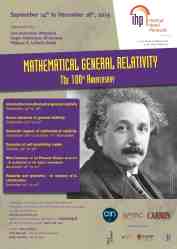
Seminar on Mathematical General Relativity
Laboratoire Jacques-Louis Lions
Sorbonne Université
Organizers
Cécile Huneau (i) Philippe G. LeFloch (ii)
Jacques Smulevici (ii) Jérémie Szeftel (ii)
(i) ENS Paris (ii) Sorbonne Université, Paris
Academic year 2026–2027
Thursday December 10 , 2026
lecture room TBA (Jussieu)
14h Jonathan LUK (Stanford) (to be confirmed)
TBA
Abstract. TBA
15h30 Andrea NUTZI (Stockholm)
TBA
Abstract. TBA
Thursday November 12 , 2026
lecture room 15-16–309 (Jussieu)
14h Raya MANCHEVA (Edinburgh)
A two-phase fluid model near weak null singularities in spherically symmetric black holes
Abstract. Understanding how matter interacts with weak null singularities (WNS) inside realistic black holes is a central problem in mathematical general relativity. In spherically symmetric black hole interiors, dust with admissible data has bounded energy density near and velocity which remains uniformly timelike near a WNS, whereas a stiff fluid has diverging energy density and a velocity asymptotically approaching an ingoing null vector. Motivated by this contrast, I will present a two-phase model for the transition from a soft phase (dust) to a hard phase (stiff fluid), triggered when the energy density reaches a threshold. The equation of state is non-differentiable at the transition. For admissible, compactly supported soft-phase data, I describe the geometry of the phase boundary. Fluid variables are continuous across achronal segments, while timelike segments form a free-boundary problem governed by the Rankine–Hugonyot jump conditions. I prove local existence and uniqueness for this problem near the singularity and show that the timelike phase boundary asymptotically approaches an ingoing null geodesic as the WNS is approached, mirroring the stiff-fluid trajectories.
15h30 Ely SANDINE (Berkeley)
Singularity formation for the Euler-Poisson System
Abstract. I will discuss singularity formation for the gravitational Euler-Poisson system. The system describes the motion of an isentropic compressible gas which self-gravitates according to Newtonian gravity. The adiabatic index of the gas serves as a criticality parameter. The system allows for steady states, stars, and features two natural singularity mechanisms: shock formation and gravitational collapse. I will discuss recent work on instability and singularity formation for this system.
Thursday October 8, 2026
cancelled du to street demonstrations
lecture room 15-25–322 (Jussieu) (changement de salle !)
14h Marios APETROAIE (Palaiseau)
(In)stability of extremal Reissner Nordstrom spacetime
Abstract. This talk will provide a brief overview of (in)stability results, spanning from the massless wave equation to nonlinear perturbations of extremal Reissner–Nordström spacetime. We will then focus on the linear perturbation theory, including results for gauge-invariant quantities such as the Teukolsky variables. Building on these results, we will address ongoing developments in establishing boundedness for gauge-dependent quantities. If time permits, we will explore mechanisms that yield only boundedness in the extremal case, contrasting this with sub-extremality, where decay is also present.
15h30 Christoph KEHLE (Zuerich)
The extremal black hole threshold
Abstract. Extremal black holes are special solutions of the Einstein equations with maximal spin or charge for their mass. In this talk, we study the threshold for black hole formation in the infinite-dimensional moduli space of spherically symmetric, asymptotically flat solutions to the Einstein-Maxwell equations coupled to a real massless scalar field. In the small scalar field regime near the Reissner-Nordström family, we show that the interface between black hole and noncollapsing solutions is a C^1 hypersurface consisting precisely of solutions that settle down to extremal Reissner-Nordström black holes. More generally, we prove that the black hole region admits C1 foliation by codimension-one stable manifolds of constant charge-to-mass ratio, up to and including extremality. We also establish universal scaling laws near the threshold: the final horizon area, the location of the event horizon, and the final temperature scale with critical exponent 1/2. This is based on joint work with Yannis Angelopoulos (University of Crete) and Ryan Unger (UC Berkeley).