
You are currently browsing the monthly archive for March 2012.
___________________________________________________________________________________________________________________________________________
Seminar on
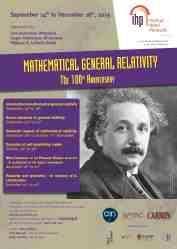
Mathematical General Relativity
Organizers:
Philippe G. LeFloch (Univ. Pierre et Marie Curie)
Ghani Zeghib (Ecole Normale Supérieure, Lyon)
ANR Project
“Mathematical General Relativity. Analysis and geometry of spacetimes with low regularity”
Thursday April 5, 2012
Laboratoire Jacques-Louis Lions, Université Pierre et Marie Curie, Paris
Lecture room 15-25 101 (first level)
10:00 am Lars Andersson (Potsdam) Hidden symmetries and conserved charges
Abstract. A proof of decay estimates for test fields with non-zero spin, e.g. Maxwell and linearized gravity, on the Kerr background is an important step towards understanding the black hole stability problem. Fields with non-zero spin on Kerr admit non-radiating modes which must be eliminated in order to prove decay. In this talk I will discuss the relation between conserved charges and hidden symmetries for linearized gravity on Minkowski space and vacuum spaces of Petrov type D, and outline the application of these ideas in proving estimates for the higher spin fields on the Kerr background.
11:30 am François Béguin (Orsay) On the BKL conjecture for vacuum spatially homogeneous models
Abstract. About forty years ago, Belinski, Kalatnikov, and Lifschitz proposed a rather complete description (based on heuristic arguments) of the asymptotic behavior of spatially homogeneous spacetimes close to their initial singularity. In particular, a “generic” vacuum spatially homogeneous spacetime is expected to exhibit a “chaotic” oscillatory behavior closed to its initial singularity. It was only in 2010 that the first rigorous mathematical results going in this direction were established. I will review here what is known (from a rigorous mathematical viewpoint) on the behavior of vacuum spatially homogeneous spacetimes close to their initial singularity. I will also try to explain what one can (or cannot) hope to prove about this asymptotic behavior and will sketch the proofs.
2:00 pm Simone Calogero (Granada) Dynamics of spatially homogeneous cosmological models
Abstract. Understanding the asymptotic dynamics of the Universe is one of the main goals of theoretical cosmology. In the context of spatially homogeneous (SH) cosmological models, where the Einstein equations of general relativity reduce to a system of ordinary differential equations, our knowledge on this problem has increased substantially over the years, thanks to the application of methods from the theory of finite dimensional dynamical systems. After reviewing the results known for the dynamics of perfect fluid cosmological models, this talk will focus on the more complicated case of a space-time filled with anisotropic matter. In the latter case the qualitative global behavior of SH solutions depends strongly on the asymptotic values of the principal pressures in the limit toward the singularity. Such behavior has been completely characterized for locally rotationally symmetric (LRS) solutions in the class A of Bianchi models. It has been found that there exist matter models, compatible with the standard energy conditions, for which Bianchi type IX LRS solutions are singularity-free for an initial data set with positive measure, and others for which the approach toward the singularity of generic solutions is oscillatory. This talk is based on a series of works in collaboration with Mark Heinzle.
3:30 pm Ghani Zeghib (Lyon) Projective transformation groups
Abstract. To pseudo-Riemannian (in particular Riemannian or Lorentzian) metric one naturally associates its Levi-Civita connection. It is also natural to ask whether, conversely, the connection determines the metric, that is, (essentially) whether two metrics having the same geodesics coincide? More strongly, two metrics are said to be projectively equivalent if their geodesics coincides as geometric non-parametrized curves. One then asks when projectively equivalent metrics coincide? The answer to this classical problem is `no’, but only for very special metrics. This confirms a real interest for this problem since it allows the emergence of special structures. We will deal here with a parallel (i.e. weaker) rigidity question: classify metrics admitting an essential projective transformation, that is, diffeomorphism preserving, non-parametrized geodesics without being an isometry?
___________________________________________________________________________________________________________________________________________
Seminar on
Mathematical General Relativity
Organizers:
Philippe G. LeFloch (Univ. Pierre et Marie Curie)
Ghani Zeghib (Ecole Normale Supérieure, Lyon)
ANR Project
“Mathematical General Relativity. Analysis and geometry of spacetimes with low regularity”
Thursday March 22, 2012
Laboratoire Jacques-Louis Lions, Université Pierre et Marie Curie, Paris
Lecture room 15-25 102 (first level)
14h Mihalis Dafermos (Cambridge) Black holes without spacelike singularities
Abstract. It is shown that for small, spherically symmetric perturbations of asymptotically flat two-ended Reissner-Nordstroom data for the Einstein-Maxwell-real scalar field system, the boundary of the dynamic spacetime which evolves is globally represented by a bifurcate null hypersurface across which the metric extends continuously. Under additional assumptions, it is shown that the Hawking mass blows up identically along this bifurcate null hypersurface, and thus the metric cannot be extended twice differentiably, in fact, cannot be extended in a weaker sense characterized at the level of the Christoffel symbols. The proof combines estimates obtained in previous work with an elementary Cauchy stability argument. There are no restrictions on the size of the support of the scalar field, and the result applies to both the future and past boundary of spacetime. In particular, it follows that for an open set in the moduli space of solutions around Reissner-Nordstrom, there is no spacelike component of either the future or the past singularity.
15h30 Rabah Souam (Paris) Harmonic diffeomorphisms and maximal surfaces
Abstract. We study the existence (or the non-existence) of harmonic diffeomorphisms between certain domains in the Euclidean two-sphere. In particular, we construct harmonic diffeomorphisms from circular domains in the complex plane onto finitely punctured spheres, with at least two punctures. This result follows from a general existence theorem for maximal graphs with isolated singularities in the Lorentzian product M x R, where M is an arbitrary n-dimensional compact Riemannian manifold (with n larger than 1). In contrast, we show that there is no harmonic diffeomorphism from the unit complex disc onto the (once) punctured sphere, and no harmonic diffeomeorphisms from finitely punctured spheres onto circular domains in the Euclidean two-sphere. This is a joint work with Antonio Alarcon.

 Mathematical general relativity, compressible fluids, and more