
You are currently browsing the category archive for the ‘GENERAL RELATIVITY’ category.
___________________________________________________________________________________________________________________________________________
Seminar on
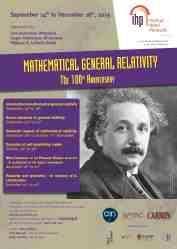
Mathematical General Relativity
Organizers:
Philippe G. LeFloch (Univ. Pierre et Marie Curie)
Ghani Zeghib (Ecole Normale Supérieure, Lyon)
With the financial support of the ANR Project
“Mathematical General Relativity. Analysis and geometry of spacetimes with low regularity”
Thursday November 3, 2011
Laboratoire Jacques-Louis Lions, Université Pierre et Marie Curie, Paris
Lecture room 15-25 326 (third floor)
14h Charles Boubel (Strasbourg) Germs of Lorentzian metrics and holonomy
Abstract. The holonomy group of a pseudo-Riemannian metric g -so e.g. a Riemannian or a Lorentzian metric- is a subgroup of O(g) which indicates, in a certain sense, how much its Levi-Civita connection fails to be flat. A central task related to those groupes is to determine the list of the subgroups of O(g) arising as holonomy, and for each item, to parametrize the set of corresponding metrics and build global examples (i.e. complete or compact). In the Riemannian case, this work is now done. We will see that, regarding holonomy matters, Lorentzian metrics behave totally differenly from Riemannian ones. I will review works of L. Bérard-Bergery, A. Ikemakhen, T. Leistner, A. Galaev, and myself, that together deal with the local aspect of the question.
15h30 David Parlongue (Nice) Breakdown criteria and extendibility in general relativity
Abstract. We will begin this talk by reviewing a geometric breakdown criterion for Einstein’s vacuum equations introduced by S. Klainerman and I. Rodnianski and various improvements (non-vacuum case, integral conditions, various gauge choices). We will then examine a spacetime localization of these criteria. We will focus on consequences in terms of formation of singularities, extendibility of spacetimes, and local regularity of foliations.
___________________________________________________________________________________________________________________________________________
Seminar on
Mathematical General Relativity
Organizers:
Philippe G. LeFloch (Univ. Pierre et Marie Curie)
Ghani Zeghib (Ecole Normale Supérieure, Lyon)
With the financial support of the ANR Project
“Mathematical General Relativity. Analysis and geometry of spacetimes with low regularity”
Thursday September 29, 2011
Laboratoire Jacques-Louis Lions, Université Pierre et Marie Curie, Paris
Lecture room 15-25 1-01 (first floor)
14h Robert Beig (Vienna) Elastic perturbations of static perfect fluid bodies: Newtonian theory
Abstract. We describe a model for static self-gravitating bodies with both fluid and elastic properties. This should allow for a rigorous existence theory of solutions near a perfect fluid configuration, e.g. ‘putting mountains on a neutron star’.
15h30 Jacques Smulevici (Orsay) Wave equations on asymptotically AdS black hole
Abstract. This is joint work with Gustav Holzelgel. We prove a logarithmic decay estimate for solutions of the linear wave equation on a slowly rotating Kerr-Anti-de-Sitter spacetime. This estimate is expected to be sharp in view of heuristics and numerics from the physics litterature. The underlying reason for the slow decay rate established here can be traced back to a stable trapping phenomenon for asymptotically anti de Sitter black holes near infinity.
___________________________________________________________________________________________________________________________________________
Seminar on
Mathematical General Relativity
Organizers: Sergiu Klainerman (Princeton)
Philippe G. LeFloch (Univ. Pierre et Marie Curie) Gabriele Veneziano (Collège de France)
With the financial support of the Fondation des Sciences Mathématiques de Paris
Monday June 13, 2011
Institut Henri Poincaré, Paris, Lecture room 314
11h Lars Andersson (Potsdam) Linear fields on Kerr spacetime
Abstract. The problem of nonlinear stability for the Kerr model of a rotating black hole is one of the central problems in general relativity. The analysis of linear fields of spin 0, 1, 2, on the Kerr spacetime is an important model problem for full nonlinear stability. I will report on recent progress on this problem.
14h Yvonne Choquet-Bruhat (IHES, Bures-sur-Yvette) Positive gravitational energy in arbitrary dimensions
Abstract. The most elegant and convincing proof of the positive energy theorem is based on spinors, as did Witten in dimension 3 +1, inspired by heuristic work by Deser and Grisaru originating from supergravity. Our aim here is to present a streamlined and complete proof, that is valid in arbitrary space dimension and uses only spinors on an oriented Riemannian space without referring to spacetime spinors.
___________________________________________________________________________________________________________________________________________
Seminar on
Mathematical General Relativity
Organizers: Sergiu Klainerman (Princeton)
Philippe G. LeFloch (Univ. Pierre et Marie Curie) Gabriele Veneziano (Collège de France)
With the financial support of the Fondation des Sciences Mathématiques de Paris
_____________________________________
Monday March 28, 2011
Laboratoire Jacques-Louis Lions
Université Pierre et Marie Curie
Lecture rooms: 15/25 101 (morning) and 15-/25 102 (afternoon)
11h Rafe MAZZEO (Stanford) The constraint equation and cylindrical ends
Abstract. This talk will give a closer look at some of the results discussed in last month’s seminar by Piotr Chrusciel concerning our joint work on the existence and classification of solutions of the constraint equations on manifolds with cylindrical ends. I will also describe some new work, with Akutagawa and Carron, concerning the Yamabe equation on stratified spaces, and some regularity theorems for all of these problems.
14h Jared SPECK (Princeton and MIT) The global stability of the Minkowski spacetime solutions to the Einstein-nonlinear electromagnetic system in wave coordinates
Abstract. The Einstein-nonlinear electromagnetic system is a coupling of the Einstein field equations of general relativity to nonlinear electromagnetic field equations. In this talk, I will discuss the family of covariant electromagnetic models that satisfy the following criteria: i) they are derivable from a sufficiently regular Lagrangian, ii) they reduce to the familiar Maxwell model in the weak-field limit, and iii) their corresponding energy-momentum tensors satisfy the dominant energy condition. I will mention several specific electromagnetic models that are of interest to researchers working in the foundations of physics and in string theory. I will then discuss my main result, which is a proof of the global nonlinear stability of the 1 + 3 dimensional Minkowski spacetime solution to the coupled system. This stability result is a consequence of a small-data global existence result for a reduced system of equations that is equivalent to the original system in a wave coordinate gauge. The analysis of the spacetime metric components is based on a framework recently developed by Lindblad and Rodnianski, which allows one to derive suitable estimates for tensorial systems of quasilinear wave equations with nonlinearities that satisfy the weak null condition. The analysis of the electromagnetic fields, which satisfy quasilinear first-order equations, is based on an extension of a geometric energy-method framework developed by Christodoulou, together with a collection of pointwise decay estimates for the Faraday tensor that I develop. Throughout the analysis, I work directly with the electromagnetic fields, thus avoiding the introduction of electromagnetic potentials.
___________________________________________________________________________________________________________________________________________
Seminar on
Mathematical General Relativity
Organizers: Sergiu Klainerman (Princeton)
Philippe G. LeFloch (Univ. Pierre et Marie Curie) Gabriele Veneziano (Collège de France)
With the financial support of the Fondation des Sciences Mathématiques de Paris
_____________________________________
Monday March 21, 2011
Laboratoire Jacques-Louis Lions
Université Pierre et Marie Curie
Lecture rooms: 15/25 1-03 (morning) and 1-02 (afternoon)
11h Ghani Zeghib (Ecole Normale Supérieure, Lyon) Sur les métriques riemanniennes dégénérées
Abstract. Une métrique riemannienne dégénérée sur une variété est un tenseur qui est une forme quadratique positive (non nécessairement définie) sur l’espace tangent de tout point de la variété. Le noyau de cette forme est un champ de plans(discontinue, e.g. de dimension variable). Le cas riemannien correspond au cas où ce champ est trivial. Le cas le plus proche est celui où ce noya est partout de dimension 1. On appellera une telle structure métrique de lumière. En fait, une métrique sous- riemannienne (de type contact) sur est essentiellement une métrique de lumière sur le fibré cotangent. On se pose ici des questions autour de la rigidité locale d’une telle structure, e.g. du fait qu’elle soit une G-structure de type fini au sens de Cartan.
14h Willie Wong (Cambridge University, UK) A local characterization of Kerr-Newman spacetimes and some applications
Abstract. In 2000, M. Mars gave a local tensorial characterisation of Kerr space-times based on earlier work of W. Simon. This characterisation was recently used by A. Ionescu and S. Klainerman in their program to study black hole uniqueness (in the vacuum case) without the assumption that the space-time is real analytic. In this talk I will describe a generalisation of the characterisation that applies to electro-vacuum space-times, and survey some results making use of it. Parts of this work is based on joint work with Pin Yu.

 Mathematical general relativity, compressible fluids, and more