
You are currently browsing the category archive for the ‘ALL SEMINARS AND CONFERENCES’ category.
___________
Seminar on Compressible Fluids
Wednesday March 16, 2011
Laboratoire Jacques-Louis Lions
Université Pierre et Marie Curie
4 Place Jussieu, 75258 PARIS
Jussieu campus. Building 15/16. Lecture room 309.
___________
- 10h00 : Shuichi Kawashima (Kyushu University) Recent progress on the stability analysis for symmetric hyperbolic systems
Abstract. We will discuss the decay property for a class of symmetric hyperbolic systems with relaxation. The Shizuta-Kawashima stability condition gives the characterization of the standard decay structure for systems with symmetric relaxation matrices. Recently, we found several interesting systems with non-symmetric relaxation which have different decay structure. In this talk, we discuss these examples and report the recent progress on the stability theory for a class of symmetric hyperbolic systems.
- 11h30 : Philippe LeFloch (Univ. Pierre et Marie Curie and CNRS) Late-time asymptotic-preserving approximations of hyperbolic equations with stiff relaxation
Abstract. We investigate the late-time asymptotic behavior of solutions to nonlinear hyperbolic systems of conservation laws containing stiff source term. On one hand, we determine the relevant asymptotic expansion, derive a reduced system in the limit, and discuss the role of an entropy condition to establish the diffusive nature of the reduced system. On the other hand, we propose a new numerical scheme of finite volume type, which allows us to recover the correct asymptotic regime. The associated discrete form of the diffusion system is achieved via a suitable discretization compatible with the stiff source term. Our theoretical results are illustrated with several models from continuum physics and numerical experiments demonstrating the relevance of the proposed theory and numerical strategy. (This is a joint work with C. Berthon and R. Turpault.)
___________
Organizers: Frédéric Coquel, Edwige Godlewski, et Philippe LeFloch
___________________________________________________________________________________________________________________________________________
Seminar on
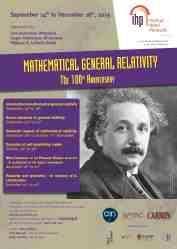
Mathematical General Relativity
Organizers: Sergiu Klainerman (Princeton)
Philippe G. LeFloch (Univ. Pierre et Marie Curie) Gabriele Veneziano (Collège de France)
With the financial support of the Fondation des Sciences Mathématiques de Paris
_____________________________________
Monday March 7, 2011
Laboratoire Jacques-Louis Lions
Université Pierre et Marie Curie
Lecture rooms: 15/25 1-03 (morning) and 1-02 (afternoon)
11h Jacques Smulevici (AEI, Potsdam) Weakly regular T2 symmetric spacetimes
Abstract. Under weak regularity assumptions, only, we develop a fully geometric theory of vacuum Einstein spacetimes with T2–symmetry, establish the global well-posedness of the initial value problem for Einstein’s field equations, and investigate the global causal structure of the constructed spacetimes. Our weak regularity assumptions are the minimal ones allowing to give a meaning to the Einstein equations under the assumed symmetry and to solve the initial value problem. First of all, we introduce a frame adapted to the symmetry in which each Christoffel symbol can be checked to belong to Lp for some p. We identify certain cancellation properties taking place in the expression of the Riemann and Ricci curvatures, and this leads us to a reformulation of the initial value problem for the Einstein field equations when the initial data set has weak regularity. Second, we investigate the future development of a weakly regular initial data set. We check that the area R of the orbits of symmetry must grow to infinity in the future timelike directions, and we establish the existence of a global foliation by the level sets of the function R. Our weak regularity assumptions only require that R is Lipschitz continuous while the metric coefficients describing the initial geometry of the orbits of symmetry are in the Sobolev space H1 and the remaining coefficients have even weaker regularity. We develop here the compactness arguments required to cover the natural level of regularity associated with the energy of the system of partial differential equations determined from Einstein’s field equations. This is a joint work in collaboration with P.G. LeFloch (Paris).
14h Erwann Delay (Univ. Avignon) Recollement des TT tenseurs
Abstract. La méthode de Corvino-Schoen permet de recoller localement et de façon lisse deux solutions des équations de contraintes. Nous verrons que l’on peut d’une façon générale recoller deux éléments du noyau de certains opérateurs à symbole surjectif et non injectif. Par exemple on peut recoller deux champs de vecteurs à divergence nulle ou deux TT-tenseurs. On en déduit par exemple que sur toute boule riemannienne ouverte, l’ensemble des TT-tenseurs lisses à support compact est de dimension infinie. On simplifie ainsi la construction de données initiales CMC.
___________
Seminar on Compressible Fluids
Wednesday February 16, 2011
Laboratoire Jacques-Louis Lions
Université Pierre et Marie Curie
4 Place Jussieu, 75258 PARIS
Jussieu campus. Building 15/16. Lecture room 309.
___________
- 10h00 : Benjamin Boutin (Rennes) Coupling techniques for nonlinear hyperbolic equations
Abstract. We investigate various analytical and numerical techniques for the coupling of nonlinear hyperbolic systems, based on an augmented formulation which allows for the modeling of the dynamics of interfaces between fluid flows. The main technical difficulty to be overcome lies in the possible resonance effect when wave speeds coincide and global hyperbolicity is lost. As a consequence, non-uniqueness of weak solutions is observed for the initial value problem which need to be supplemented with further admissibility conditions.
- 11h30 : Christophe Berthon (Nantes) Quelques résultats sur la stabilité des solveurs approchés de Riemann pour les équations d’Euler gaz réels
Abstract. Dans cet exposé, on s’intéressera à l’obtention d’inégalités discrètes d’entropie qui doivent être satisfaites par les schémas numériques lors de l’approximation des solutions faibles des équations d’Euler pour une thermodynamique de type gaz réels. Après avoir rappelé quelques résultats, avec une attention toute particulière sur les inégalités discrètes d’entropie pour les schémas de relaxation, nous établissons plusieurs critères de stabilité qui généralisent les résultats précédents. Les résultats proposés présentent un second intérêt puisqu’ils portent uniquement sur le solveur approché de Riemann et aucune étape de « relaxation » (ou de prise en compte d’un terme source raide) n’est ici suggérée.
___________
Organizers: Frédéric Coquel, Edwige Godlewski, et Philippe LeFloch
___________________________________________________________________________________________________________________________________________
Seminar on
Mathematical General Relativity
Organizers: Sergiu Klainerman (Princeton)
Philippe G. LeFloch (Univ. Pierre et Marie Curie) Gabriele Veneziano (Collège de France)
With the financial support of the Fondation des Sciences Mathématiques de Paris
_____________________________________
Monday February 14, 2011
Institut Henri Poincaré
Lecture room 01
11h – Qian Wang (IHES & Albert Einstein Institute, Potsdam) Breakdown criterion for Einstein Vacuum equations in CMC gauge
Abstract. I will report my recent work on the geometric criterion for the breakdown of Einstein vacuum space-times with the constant mean curvature (CMC) foliation. In this work, the criterion is formulated in terms of time-integrability of the sup- norms of the second fundamental form and derivatives of the lapse function associated to CMC foliation of the space-time. This result is obtained through deriving uniform lower bound on the null radius of injectivity of the light cones. I will sketch the main idea of the proof.
14h – Piotr Chrusciel (Vienna) On the general relativistic constraint equations
Abstract. I will present some new results with Rafe Mazzeo on the construction of solutions of the constraint equations with cylindrical ends.
___________________________________________________________________________________________________________________________________________
Seminar on
Mathematical General Relativity
Organizers: Sergiu Klainerman (Princeton)
Philippe G. LeFloch (Univ. Pierre et Marie Curie) Gabriele Veneziano (Collège de France)
With the financial support of the Fondation des Sciences Mathématiques de Paris
_____________________________________
Monday January 31rst, 2011
Institut Henri Poincaré
Lecture room 314
11h Lydia Bieri (Ann Arbor), Geometry of Spacetimes Solving the Einstein-Maxwell Equations in General Relativity and Gravitational Radiation
Abstract. A major goal of mathematical General Relativity (GR) and astrophysics is to precisely describe and finally observe gravitational radiation, one of the predictions of GR. In order to do so, one has to study the null asymptotical limits of the spacetimes for typical sources. Among the latter we find binary neutron stars and binary black hole mergers. In these processes typically mass and momenta are radiated away in form of gravitational waves. D. Christodoulou showed that every gravitational-wave burst has a nonlinear memory. In this talk, we discuss the null asymptotics for spacetimes solving the Einstein-Maxwell (EM) equations, compute the radiated energy and derive limits at null infinity and compare them with the Einstein vacuum (EV) case. The physical insights are based on geometric-analytic investigations of the solution spacetimes.
14h Jérémie Szeftel (ENS, Paris) Around the bounded L2 curvature conjecture in general relativity
Abstract. We report on recent progress obtained on the construction and control of a parametrix to the homogeneous wave equation on a curved background, where the metric is a rough solution to the Einstein vacuum equations. Controlling such a parametrix as well as its error term when one only assumes L2 bounds on the curvature tensor of the metric is a major step towards the proof of the bounded L2 curvature conjecture. This is a joint work with Sergiu Klainerman and Igor Rodnianski.

 Mathematical general relativity, compressible fluids, and more