You are currently browsing the category archive for the ‘ALL SEMINARS AND CONFERENCES’ category.
_____________________________________________________________________________________________________________
Workshop 2016
“Modeling and Computation of Shocks and Interfaces”
Laboratoire Jacques-Louis Lions
Université Pierre et Marie Curie, Paris
Organizers
Philippe G. LeFloch (Paris)
Charalambos Makridakis (Brighton)
Supported by the ModCompShock ITN project
and a project PICS CNRS
Dec. 6 around 1:30pm to Dec. 8 around 1pm
Main speakers
Remi Abgrall (Zurich)
Benjamin Boutin (Rennes)
Christophe Chalons (Versailles)
Sergey Gavrilyuk (Marseille)
Charalambos Makridakis (Brighton)
Pierangelo Marcati (L’Aquila)
Siddhartha Mishra (Zurich)
Carlos Pares (Malaga)
Nils Risebro (Oslo)
Giovanni Russo (Catania)
Lev Truskinovsky (Palaiseau)
Titles of the lectures
Benjamin Boutin Numerical boundary layers for linear hyperbolic IBVP and semigroup estimate
Christophe Chalons On the computation of non conservative products and cell averages in finite volume methods
Makridakis Charalambos Energy/entropy consistent computational methods
Sergey Gavrilyuk Shock-droplet interaction via a new hyperbolic phase field model
Pierangelo Marcati Splash singularities for incompressible viscoelatic fluids
Siddhartha Mishra Statistical solutions of systems of conservation laws
Carlos Pares Entropy stable schemes for degenerate convection-diffusion equations
Nils Risebro Numerical methods for scalar conservation laws with a stochastically driven flux
Giovanni Russo Shock capturing schemes for all Mach number flow in gas dynamics
Lev Truskinovsky Solitary waves in the FPU lattice: from quasi-continuum to anti-continuum limit
Schedule of the workshop
Tuesday afternoon
2pm-2:45pm: C. Makridakis
2:45-3:30pm: C. Pares
3:30pm: coffee break
4pm-4:45pm G. Russo
Wednesday morning
10am-10:45am: S. Gavrilyuk
10:45am: coffee break
11:15am: C. Chalons
Noon: lunch buffet
Wednesday afternoon
2pm-2:45pm R. Abgrall
2:45pm-3:30pm S. Mishra
3:30am coffee break
4pm L. Truskinovsky
Thursday morning
9:30am-10:15am N. Risebro
10:15am coffee break
10:45am B. Boutin
11:30am P. Marcati
12:15 lunch buffet (end of the workshop)
Participants to the workshop
- Remi Abgrall (Zurich) remi.abgrall at math.uzh.ch
- Benjamin Boutin (Rennes) chalons at math.jussieu.fr
- Christophe Chalons (Versailles) chalons at math.jussieu.fr
- Yangyang Cao (Paris) caoyangyang0721 at 163.com
- Marco De Lorenzo (Paris) marco.de-lorenzo at edf.fr
- Christian Dickopp (Aachen) dickopp at web.de
- Alain Forestier (Saclay) alain.forestier at cea.fr
- Sergey Gavrilyuk (Marseille) sergey.gavrilyuk at univ-amu.fr
- Maren Hantke (Magdeburg) maren.hantke at ovgu.de
- David Iampetro (Marseille) david.iampietro at edf.fr
- Philippe G. LeFloch (Paris) contact philippelefloch.org
- Charalambos Makridakis (Brighton) C.Makridakis at sussex.ac.uk
- Pierangelo Marcati (L’Aquila) pierangelo.marcati at gssi.infn.it
- Christoph Matern (Magdeburg) christoph.matern at ovgu.de
- Siddhartha Mishra (Zurich) siddhartha.mishra at sam.math.ethz.ch
- Roberto Molina (Paris) rmolina.sep at gmail.com
- Hieu Nguyen (Aachen) nguyen at instmath.rwth-aachen.de
- Carlos Pares (Malaga) pares at anamat.cie.uma.es
- Yohan Penel (Paris) penel at ann.jussieu.fr
- Chaoyu Quan (Paris) quanchaoyu at gmail.com
- Pierre-Arnaud Raviart (Paris) pa at raviart.com
- Nils Risebro (Oslo) nilshr at math.uio.no
- Giovanni Russo (Catania) russo at dmi.unict.it
- Lev Truskinovsky (Palaiseau) trusk at lms.polytechnique.fr
- Shugo Yasuda (Hyogo) yasuda at sim.u-hyogo.ac.jp
- Dimitrios Zacharenakis (Stuttgart) zachards at mathematik.uni-stuttgart.de
Other practical informations
The workshop will take place in the main lecture room 309 of the Laboratoire Jacques-Louis Lions, Université Pierre et Marie Curie, which is located in the building 15-16.
Address: 4 Place Jussieu, 75258 Paris. Subway station: Jussieu.
List of hotels in the vicinity of the university
11th DFG–CNRS WORKSHOP Micro-Macro Modeling and Simulation of Liquid-Vapor Flows
organized with the financial support of
DFG, CNRS, and ITN
Wednesday March 2nd, 2016 (afternoon)
to Friday March 4th, 2016 (at noon)
Laboratoire Jacques-Louis Lions, Université Pierre et Marie Curie, 4, Place Jussieu, Paris. Subway station: Jussieu
Lecture room 15-16 — 309
____________________________
INVITED SPEAKERS
Nina Aguillon (Paris)
Christophe Berthon (Nantes)
Christophe Chalons (Versailles)
Frédéric Coquel (Palaiseau)
Johannes Daube (Freiburg)
Bruno Després (Paris)
Christian Dickopp (Aachen)
Florence Drui (Châtenay-Malabry)
Robert Eymard (Marne-La-Vallée)
Jan Giesselman (Stuttgart)
Philippe Helluy (Strasbourg)
Mirko Kraenkel (Freiburg)
Dietmar Kroener (Freiburg)
Rüdiger Müller (Berlin)
Carlos Pares (Malaga)
Arnold Reusken (Aachen)
____________________________
Main organizer
Philippe G. LeFloch (Paris)
Co-organizers
Dietmar Kroener (Freiburg)
Frédéric Coquel (Palaiseau)
SCHEDULE
Wednesday afternoon (Chairman P.G. LeFloch)
14h30 -15h Robert Eymard (Marne-La-Vallée)
15h – 15h30 Jan Giesselman (Stuttgart)
15h30 – 16h Coffee break
16h-16h30 Philippe Helluy (Strasbourg)
16h30-17h Mirko Kraenkel (Freiburg)
Thursday morning (Chairman Jan Giesselman)
10h-10h30 Christophe Berthon (Nantes)
10h30-11h Johannes Daube (Freiburg)
11h-11h30 Coffee break
11h30-12h Christophe Chalons (Versailles)
12h-12h30 Dietmar Kroener (Freiburg)
12h30-14h30 Lunch break
Thursday afternoon (Chairman F. Coquel)
14h30-15h Bruno Després (Paris)
15h-15h30 Arnold Reusken (Aachen)
15h30-16h Coffee break
16h-16h30 Nina Aguillon (Paris)
16h30-17h Rüdiger Müller (Berlin)
Friday morning (Chairman D. Kroener)
10h-10h30 Carlos Pares (Malaga)
10h30-11h Florence Drui (Châtenay-Malabry)
11h-11h30 Coffee break
11h30-12h Christian Dickopp (Aachen)
12h-12h30 Frédéric Coquel (Palaiseau)
TITLES and ABSTRACTS
Nina Aguillon (Paris) Numerical approximation of hyperbolic systems containing an interface
Abstract. We present an approach to approximate numerically the solution of coupled hyperbolic conservation laws. The coupling is achieved through a fixed interface, in which interface conditions are linking the traces on both sides. The main interest of the scheme is that it does not use the knowledge of the solution to the Riemann problem, and hence it is quite flexible and easy to implement. The idea of the scheme is to balance the effects ot the waves that enter the interface, in order to numerically mimic the structure of the Riemann problem. The scheme is well balanced with respect to all the piecewise equilibria associated with the interface conditions. If one of the interface condition is the conservation of a conserved variable, the scheme maintains it exactly. We will present a detailed analysis in the classical case, and a variety of test cases assessing the quality of the method. This is a joint work with Raul Borsche (Technische Universität Kaiserslautern)
Christophe Berthon (Nantes) Numerical convergence rate for a diffusive limit of hyperbolic systems: p-system with damping
Christophe Chalons (Versailles) On all regime Lagrangian-remap numerical schemes for compressible fluid systems
Abstract. It is the purpose of this contribution to provide an overview on recent advances in the development of all-regime Lagrange-Remap numerical schemes for compressible fluids systems with source terms. We will consider in particular the case of large friction coefficients and the case of low-Mach numbers. More precisely, we will present a discretization strategy for gas dynamics equations for unstructured grids based on a Lagrange-Remap approach that does not involve any moving mesh. A natural semi-implicit extension of the method that allows to remain stable under a CFL condition involving only the material velocity will be given, together with an extremely simple modification that allows to provide an accurate and stable solver for simulations involving low-Mach regions in the flow. The stability properties of the proposed schemes and several numerical experiments will be presented. This contribution is based on a series of joint works with Mathieu Girardin and Samuel Kokh. These works were performed during M. Girardin’s PhD thesis.
Johannes Daube (Freiburg) Sharp interface limit for the Navier–Stokes–Korteweg model
Abstract. The Navier–Stokes–Korteweg model, an extension of the compressible Navier–Stokes equations, is a diffuse interface model for liquid-vapour flows which allows for phase transitions. In the model, a small parameter represents the thickness of an interfacial area, where phase transitions occur. Its static version was studied by Hermsdoerfer, Kraus and Kroener and the corresponding interface conditions were obtained. Assuming convergence of an associated energy functional to a suitable surface measure, we will perform the sharp interface limit in the dynamic case. More precisely, by means of compactness, we will ensure that solutions to the diffusive Navier-Stokes-Korteweg equations converge to solutions of an appropriate sharp interface model as the interface thickness tends to zero. This is joint work with H. Abels (Regensburg), C. Kraus (Wuerzburg-Schweinfurt) and D. Kroener (Freiburg).
Bruno Després (Paris) Modeling uncertainties with kinetic equations
Abstract: The modeling of uncertainties is fundamental in industry and in CFD. For nonlinear equations, it questions the compatibility of L1-BV techniques (for conservation laws) with L2 approaches (for the uncertainties). I will review recent progresses on the modeling at the kinetic level (with B. Perthame), and present recent ideas which show connection of the so-called kinetic polynomials with optimal control (with E. Treat).
Christian Dickopp (Aachen) Coupling of (elastic)-plastic solids with compressible two-phase fllows for cavitation damaging
Abstract. As a model problem to investigate cavitation damaging the collapse of a single gas bubble collapsing near to an elastic or elastic-plastic solid wall is simulated numerically. This transient three-phase system is modeled by the compressible Euler equations completed by a stiffened gas law for both fluids, where the liquid and the gas phase are distinguished by a level set approach, and either the pure elastodynamical equations for a linear-elastic solid or an extension to describe plastic effects. A weak coupling strategy connects the alternating calculations of the fluid solver and the solid solver using transient boundary conditions that are updated by the other solver.
Florence Drui (Châtenay-Malabry) A hierachy of homogeneous two-fluid models and numerical methods for simulating various regimes of two-phase flows
Abstract. Compressible two-fluid models offer a potential solution for simulating separated two-phase flows configurations. On the other hand, a specific family of such models has been developed for the regime of dispersed gas bubbles and show good agreement with experiments in the case of small acoustic perturbations. On the way to connect both types of flows, we propose here a hierarchy of homogeneous two-fluid models. Starting with Hamilton’s variational principle and adding thermodynamically consistent dissipative structures, we built a new connected hierarchy, each level of which being mathematically well-posed. Every new relaxation small parameter is physically identified through acoustic linearization and analysis of the systems dispersion relations. Furthermore, numerical methods based on finite volume schemes are developed so as to preserve the properties of the models at the continuous level and to asymptotically handle the transition from each subsystem to another. Finally, simulations of simple academic configurations are performed and show the expected properties of the first models of the hierarchy, the numerical methods and dynamically adaptive mesh techniques with the potential for massively parallel simulations.
Robert Eymard (Marne-La-Vallée) Convection and total variation flow
Abstract. We consider a simplified model, related to the flow of a nonNewtonian fluid. This simplified model consists in a scalar nonlinear hyperbolic equation, regularized by the total variation flow operator (or 1-Laplace operator). We give an entropy weak formulation, for which we prove the uniqueness of the solution using the doubling variable technique. We provide an existence result using the convergence of a numerical scheme, a splitting scheme where the hyperbolic flow is treated with finite volumes and the total variation flow with finite elements. Finally, some numerical simulations in 1D and 2D are presented. This work is a joint work with F. Bouchut and D. Doyen.
Jan Giesselman (Stuttgart) A priori error analysis of DG approximations of two-phase flows
Abstract. In this talk we consider a one dimensional model for isothermal two-phase flows using Lagrangian coordinates. The model is of diffuse interface type with a non-monotone pressure law. We will present a priori error analysis of a semi-discrete discontinuous Galerkin method, which satisfies a discrete version of the energy inequality which is valid on the continuous level. It also satisfies a relative energy type stability theory. Combining this stability framework with suitable projection operators for the exact solution allows us to derive optimal order error estimates. We will also present numerical results obtained using a fully-discrete version of the scheme, which validate our theoretical results.
Philippe Helluy (Strasbourg) Task-based parallelization of a transport discontinuous Galerkin solver and applications.
Abstract. We present an implicit discontinuous Galerkin solver for the transport equation. Due to the upwind nature of the numerical flux, the linear system in the implicit step is block triangular. The scheme is thus well adapted to a task-based implementation. We present such an implementation using the StarPU library and we discuss applications to fluid dynamics.
Mirko Kraenkel (Freiburg) Discontinuous Galerkin schemes for the Navier-Stokes-Allen-Cahn system
Dietmar Kroener (Freiburg) Conservation laws on surfaces
Rüdiger Müller (Berlin) The Lippmann equation for liquid metal electrodes
Abstract. The Lippmann equation is considered as universal relationship between interfacial tension, double layer charge, and cell potential. Recently we have derived a general thermodynamically consistent model for electrochemical interfaces, which shows a remarkable agreement to single crystal experimental data. In this talk, we apply the model to a curved liquid metal electrode in contact with an electrolyte. By matched asymptotic analysis we obtain the Lippmann equation whenever the Debye length is small compared to electrode curvature radius. The interfacial tension of the Lippmann equation is composed of the surface tension of our general model, and additional contributions arising from the adjacent space charge layers. Comparison with experimental data of several mercury-electrolyte interfaces confirms the theoretical results. This is a joint work with Wolfgang Dreyer, Clemens Guhlke, and Manuel Landstorfer.
Carlos Pares (Malaga) Nonconservative products and Shallow Water models: an overview
Abstract. Many hyperbolic nonlinear PDE systems that include source terms and nonconservative products arise in the simulation of geophysical flows by means of depth-averaged models. In this talk, a review of the numerical techniques developed in last years by my group of research and collaborators to solve this type of systems will be presented together with a discussion of the main difficulties and challenges in this field. Some applications to the simulation of real flows will be shown to illustrate this topic.
Arnold Reusken (Aachen) Space-time unfitted FEM for problems with moving discontinuities
Abstract. In this talk we will discuss unfitted finite element methods (or CutFEM) in a space-time setting. The motivation for the development of these methods comes from two-phase incompressible flows. We explain how these techniques can be applied for the accurate discretization of a mass transport equation and a two-phase flow (Navier-)Stokes equation. The idea of the method, rigorous error bounds for certain problem classes and results of numerical experiments will be presented.
Partial LIST of Participants
Boris Andreianov boris.andreianov at lmpt.univ-tours.fr
Robert Eymard robert.eymard at univ-mlv.fr
Jan Giesselmann jan.giesselmann@mathematik.uni-stuttgart.de
Philippe Helluy helluy at math.u-strasbg.fr
Mirko Keaenkel kraenkel at mathematik.uni-freiburg.de
Bruno Despres despres at ann.jussieu.fr
Christophe Berthon christophe.berthon at math.univ-nantes.fr
Philippe LeFloch contact at philippelefloch.org
Ruediger Mueller mueller at wias-berlin.de
Arnold Reusken reusken at igpm.rwth-aachen.de
Carlos Parés pares at anamat.cie.uma.es
Johannes Daube hannes at mathematik.uni-freiburg.de
Chalons Christophe christophe.chalons@uvsq.fr
Nina Aguillon aguillon at ljll.math.upmc.fr
Christian Dickopp dickopp at web.de
Florence Drui florence.drui at centralesupelec.fr
Emmanuel Audusse eaudusse at yahoo.fr
Gautier Dakin gautier.dakin at gmail.com
Roland Duclous roland.duclous at gmail.com
Mehdi Khalloufi mehdi.khalloufi at mines-paristech.fr
Pierre-Arnaud Raviart pa at raviart.com
Frederic Coquel frederic.coquel at cmap.polytechnique.fr
Dietmar Kroener dietmar at mathematik.uni-freiburg.de
____________________________
PRACTICAL INFORMATIONS
How to come to the Laboratoire Jacques-Louis Lions
Hotels near the University Pierre et Marie Curie
____________________________
EARLIER WORKSHOPS “Micro-Macro Modeling and Simulation of Liquid-Vapor Flows”
Tenth Workshop, Freiburg, February 2015
Ninth Workshop, Paris, February 2014
Eight Workshop, Berlin, February 2013
Seventh Workshop, Paris, February 2012
Sixth Workshop, Stuttgart, January 2011
Fifth Workshop, Strasbourg, April 2010
Fourth Workshop, Aachen, February 2009
Third Workshop, Strasbourg, January 2008
Second Workshop, Bordeaux, November 2007
Opening Workshop, Kirchzarten, November 2005
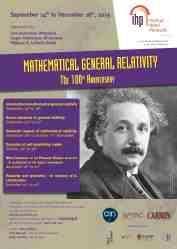
September 14, 2015 to December 18, 2015
Trimester Program at the
Centre Emile Borel
Financial support provided by Institut Henri Poincaré
and ANR Project “Mathematical General Relativity”
Organizers
Lars Andersson (Potsdam)
Sergiu Klainerman (Princeton)
Philippe G. LeFloch (Paris)
MAIN THEMES OF THE PROGRAM
Einstein’s field equation of general relativity is one of the most important geometric partial differential equations. Over the past decade, the mathematical research on Einstein equation has made spectacular progress on many fronts (Cauchy problem, cosmic censorship, asymptotic behavior). These developments have brought into focus the deep connections between the Einstein equation and other important geometric PDE’s, including the wave map equation, Yang-Mills equation, Yamabe problem, as well as Hamilton’s Ricci flow. The field is of growing interest for mathematicians and of intense current activity, as is illustrated by major recent breakthrough, concerning the uniqueness and stability of the Kerr black hole model, the formation of trapped surfaces, and the bounded L2 curvature problem. Specifically, the themes of mathematical interest that will be developed in the present Program and are currently most active include:
- The initial value problem for Einstein equation and the causal geometry of spacetimes with low regularity, formation of trapped surfaces
- Techniques of Lorentzian geometry: injectivity radius estimates, geometry of null cones; construction of parametrix
- Geometry of black hole spacetimes: uniqueness theorems, censorship principles
- Coupling of Einstein equation for self-gravitating matter models, weakly regular spacetimes, nonlinear stability of Minkowski space with matter
General schedule for the Trimester
SCIENTIFIC ACTIVITIES during the Trimester
- Workshops and Conferences (see below)
- On the Mathematical Theory of Black Holes, Course by S. Klainerman.
- Begins on October 13 from 2pm to 4:30pm, and the following Tuesdays.
- Video of the lectures
- An Introduction to Self-Gravitating Matter, Course by P.G. LeFloch.
- Begins on October 9 from 2pm to 4:30pm, and the following Fridays.
- LECTURE NOTES for this course
- Video 1: An introduction to self-gravitating matter
- Video 2: Modified gravity and weakly regular spacetimes
- Video 3: Weak solutions to the Einstein equations
- Video 4: Weakly regular Cauchy developments
- Video 5: Self-gravitating fluids with bounded variation
- Video 6: The geometry of weakly regular spacetimes
- Video 7: Nonlinear stability of Minkowski space for massive fields
- Weekly Seminar on Mathematical General Relativity
- organized by L. Andersson, jointly with S. Klainerman, P.G. LeFloch, J. Szeftel (Paris), and A. Zeghib (Lyon).
- Begins on October 7 from 2pm to 4:30pm, and the following Wednesdays.
- Speakers in the Seminar :
- Bruno Premoselli (Cergy-Pontoise), Martin Taylor (Cambridge, UK)
- Steffen Aksteiner (Potsdam), Lars Andersson (Potsdam)
- Jesus Oliver (San Diego)
- Anne Franzen (Utrecht), Jared Wunsch (Evanston)
- Sung-Jin Oh (Berkeley), Anna Sakovich (Vienna)
- Hans Lindblad (Baltimore), Florian Beyer (Dunedin)
- VIDEOS available (courses, main conference)
- Tea break every day 3pm-3:30pm
WORKSHOPS AND CONFERENCES
Sept. 14 to 18, 2015 Summer School – INTRODUCTION TO MATHEMATICAL GENERAL RELATIVITY
List of speakers
Greg Galloway (Miami)
Gerhard Huisken (Tuebingen)
Hans Ringstrom (Stockholm)
Sept. 23 to 25, 2015 Workshop – RECENT ADVANCES IN MATHEMATICAL GENERAL RELATIVITY
List of speakers
Spyros Alexakis (Toronto)
Piotr Chrusciel (Vienna)
Joao Costa (Lisbon)
Semyon Dyatlov (Cambridge, USA)
Stefan Hollands (Cardiff)
Alexandru Ionescu (Princeton)
Lionel Mason (Oxford)
Vincent Moncrief (Yale)
Jean-Philippe Nicolas (Brest)
Harvey Reall (Cambridge, UK)
Hans Ringstrom (Stockholm)
Mu-Tao Wang (New York)
Sept. 28 to Oct. 1, 2015 Workshop – GEOMETRIC ASPECTS OF MATHEMATICAL RELATIVITY (Hold in Montpellier and organized by Marc Herzlich and Erwann Delay)
List of speakers
Piotr Chrusciel (Vienna)
Michael Eichmair (Zürich)
Mu-Tao Wang (New York)
Oct. 26 to 29, 2015 Workshop – DYNAMICS OF SELF-GRAVITATING MATTER
List of speakers
Hakan Andreasson (Gothenburg)
Thierry Barbot (Avignon)
Robert Beig (Vienna)
David Fajman (Vienna)
Marc Mars (Salamanca)
David Maxwell (Fairbanks)
Todd Oliynyk (Monash)
Volker Schlue (Toronto)
Bernd Schmidt (Potsdam)
Jared Speck (Cambridge, USA)
Shadi Tahvildar-Zadeh (Rutgers)
Eric Woolgar (Alberta)
Nov. 16 to 20, 2015 International Conference – GENERAL RELATIVITY – A Celebration of the 100th Anniversary
List of speakers Schedule and title
Jean-Pierre Bourguignon (Bures-sur-Yvette)
Demetrios Christodoulou (Zürich & Athens)
Mihalis Dafermos (Princeton)
Thibault Damour (Bures-sur-Yvette)
Georges Ellis (Cape Town)
Richard Hamilton (New York)
Gustav Holzegel (London)
Jonathan Luk (Cambridge, UK)
Roger Penrose (Oxford)
Richard Schoen (Stanford & Irvine)
Jacques Smulevici (Orsay)
Jérémie Szeftel (Paris)
Robert Wald (Chicago)
Qian Wang (Oxford)
Dec. 14 to 16, 2015 International Conference- RELATIVITY AND GEOMETRY – IN MEMORY OF A. LICHNEROWICZ (Organized by Giuseppe Dito, Jean-Pierre Francoise, Paul Gauduchon, Richard Kerner, Yvette Kosmann-Schwarzbach et Daniel Sternheimer)
List of speakers
Olivier Biquard (Paris 6)
Robert Bryant (Durham)
Pierre Cartier (Gif-Sur-Yvette)
Thibault Damour (Gif-Sur-Yvette)
Nathalie Deruelle (Paris 7)
Simon Donaldson (Stony Brook & London)
Michel Dubois-Violette (Paris 11)
Charles Francès (Strasbourg)
Edward Frenkel (Berkeley)
Christian Fronsdal (Los Angeles)
Simone Gutt (Bruxelles)
James Isenberg (Eugene)
Sergiu Klainerman (Princeton)
Maxim Kontsevich (Gif-Sur-Yvette)
Alan Weinstein (Berkeley)
Program coordinated by the Centre Emile Borel at IHP. Financial support provided by the Institut Henri Poincaré and the ANR Project “Mathematical General Relativity. Analysis and geometry of spacetimes with low regularity”.
_____________________________________________________________________________________________________________
Organizers
Michael Anderson (Stony Brook)
Sergiu Klainerman (Princeton)
Philippe G. LeFloch (Paris)
Jared Speck (Cambridge, USA)
Location: Simons Center for Geometry and Physics
Date: One-month concentration period in January 2015
Workshop from January 20 to 23, 2015
Einstein’s field equation of general relativity is one of the most important geometric partial differential equations. Over the past decade, the mathematical research on Einstein equation has made spectacular progress on many fronts, including the Cauchy problem, cosmic censorship, and asymptotic behavior. These developments have brought into focus the deep connections between the Einstein equation and other important geometric partial differential equations, including the wave map equation, Yang-Mills equation, Yamabe equation, as well as Hamilton’s Ricci flow. The field is of growing interest for mathematicians and of intense current activity, as is illustrated by major recent breakthroughs concerning the uniqueness and stability of black hole models, the formation of trapped surfaces, and the bounded L2 curvature problem. The themes of mathematical interest that will be particularly developed in the present Program include the formation of trapped surfaces and the nonlinear interaction of gravitational waves. The new results are based on a vast extension of the earlier technique by Christodoulou and Klainerman establishing the nonlinear stability of the Minkowski space. This Program will be an excellent place in order to present the recent breakthrough on the bounded L2 curvature problem for the Einstein equation, which currently provides the lower regularity theory for the initial value problem, as well as the recently developed theory of weakly regular Einstein spacetimes with distributional curvature.
Long-term participants
Michael Anderson (Stony Brook)
Piotr Chrusciel (Vienna)
Mihalis Dafermos (Princeton)
Cécile Huneau (Paris)
Alexandru D. Ionescu (Princeton)
James Isenberg (Eugene)
Sergiu Klainerman (Princeton)
Philippe G. LeFloch (Paris)
Jared Speck (Cambridge, USA)
Jinhua Wang (Hangzhou)
Mu-Tao Wang (New York)
Qian Wang (Oxford)
Willie Wong (Lausanne)
Speakers during the Workshop
- Tuesday January 20
- Sung-Ji Oh (Berkeley) Linear instability of the Cauchy horizon in subextremal Reissner-Nordström spacetime under scalar perturbations
- Volker Schlue (Toronto) Stationarity of time-periodic vacuum spacetimes
- Alexandru D. Ionescu (Princeton) The Euler–Maxwell system for electrons: global solutions in 2D
- Joachim Krieger (Lausanne) Concentration-compactness for the critical Maxwell-Klein-Gordon equation
- Wednesday January 21
- Xianliang An (Piscataway) Two results on formation of trapped surfaces
- Tahvildar-Zadeh (Piscataway) The Dirac electron and the Kerr-Newman spacetime
- Mihalis Dafermos (Princeton)
- Jim Isenberg (Eugene) Asymptotically hyperbolic shear-free solutions of the Einstein constraint equations
- Thursday January 22
- Cécile Huneau (Paris) Stability in exponential time of Minkowski
- Jacques Smulevici (Orsay) Vector field methods for transport equations with applications to the Vlasov-Poisson system
- Mu-Tao Wang (New York) Quasi-local angular momentum and the limit at infinity
- Spyros Alexakis (Toronto) The Penrose inequality for perturbations of the Schwarzschild exterior
- Friday January 23
- Mihai Tohaneanu (Statesboro) Pointwise decay for the Maxwell system on black holes
- Qian Wang (Oxford)
- Peter Blue (Edinburgh) Revisiting decay of fields outside a Schwarzschild black hole
- Philippe G. LeFloch (Paris) Weak solutions to the Einstein equations in spherical or T2 symmetry
_____________________________________________________________________________________________________________
Organizers
Philippe G. LeFloch (Paris)
Jérémie Szeftel (Paris)
Ghani Zeghib (Lyon)
ANR Project
“Mathematical General Relativity. Analysis and geometry of spacetimes with low regularity”
Wednesday June 17, 2015
Laboratoire Jacques-Louis Lions, Université Pierre et Marie Curie, Paris
Lecture room 15/25-326
11h Emmanuel Hebey (Cergy-Pontoise) Systèmes de Kirchhoff critiques stationnaires sur des variétés compactes
14h Lydia Bieri (Ann Arbor) Gravitational radiation and two types of memory
Abstract. We are believed to live on the verge of detection of gravitational waves, which are predicted by General Relativity. In order to understand gravitational radiation, we have to investigate analytic and geometric properties of corresponding solutions to the Einstein equations. Gravitational waves leave a footprint in the spacetime regions they pass, changing the manifold – and therefore displacing test masses – permanently. This is known as the memory effect. It has been believed that for the Einstein equations, being nonlinear, there exists one such effect with a small `linear’ and a large `nonlinear’ part. In this talk, I present some of my joint work with D. Garfinkle showing that these are in fact two different effects.