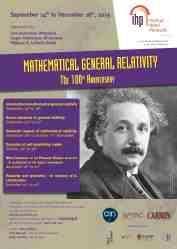
___________

Seminar on Compressible Fluids

Wednesday May 18, 2011

Laboratoire Jacques-Louis Lions

Université Pierre et Marie Curie

4 Place Jussieu, 75258  PARIS

Jussieu campus. Building 15/16. Lecture room 309.

___________

  • 11h – Siddhartha MISHRA (ETH, Zurich) Entropy stable high-order schemes for systems of conservation laws

Abstract. We design arbitrarily high-order schemes for systems of conservation laws that satisfy a discrete version of the entropy inequality. Consequently, these schemes are stable in L2. The proposed schemes are based on a combination of arbitrarily high-order entropy conservative schemes together with numerical diffusion operators. The numerical diffusion operators require an ENO reconstruction of the entropy variables. The resulting schemes are shown to be entropy stable for conservation laws in several space dimensions. Recent work extending these schemes to the fully discrete case and to unstructured meshes based on a shock-capturing space time Discontinuous Galerkin (DG) method will be mentioned. Numerical experiments illustrating the robust performance of the proposed schemes are presented. The talk is based on joint work with U. S. Fjordholm, A. Hiltebrand (ETH, Zurich) and E. Tadmor (University of Maryland, U.S.A).

___________

Organizers. Frédéric Coquel, Edwige Godlewski, Philippe LeFloch

___________

Seminar on Compressible Fluids

Wednesday March 30, 2011

Laboratoire Jacques-Louis Lions

Université Pierre et Marie Curie

4 Place Jussieu, 75258  PARIS

Jussieu campus. Building 15/16. Lecture room 309.

___________

Abstract. Récemment, des nouvelles méthodes numériques ont été formulées pour résoudre les équations d’Euler incompressible. Il s’agit d’intégrateurs variationels basés sur la discrétisation du groupe des difféomorphismes qui préservent le volume. Ces nouvelles méthodes ont des propriétés attrayantes : – elles conservent l’énergie et les théorèmes de circulation de Kelvin, – elles ne sont pas plus coûteuses que des méthodes de différences finies ordinaires, – elles respectent la structure géométrique et Hamiltonienne des équations, – elles sont applicables sur des grilles 2D ou 3D non structurées. Dans ce séminaire nous présentons ces nouvelles méthodes et montrons comment les généraliser aux modèles de fluides géophysiques (Boussinesq, équations primitives) tout en respectant les bonnes propriétés énoncées ci-dessus.


Abstract. We consider a nonlinear diffusion equation with a cubic-like diffusion function arising in the context of phase transitions (in the spirit of the Cahn–Hilliard equation). Because of the non-monotonicity of the diffusion function, the Cauchy problem is ill-posed. To restore the well-posedness, it is possible to take into consideration a generalized formulation determined by considering the forward-backward equation as the singular limit of a corresponding higher order equation, given by the addition of a third order term (two space and one time derivative) of Sobolev type, different with respect to the fourth-space derivative term considered in the case of Cahn–Hilliard equations. Because of some analogies with the case of hyperbolic conservation laws, such kind of solutions has been called entropy solutions for the forward-backward diffusion equation. The aim of the talk is to present and discuss the entropy framework for this equation, with particular attention given to solutions taking values in the zones where the diffusion function is monotone increasing. Joint works with A.Terracina, A. Tesei and P.Lafitte.

___________

Organizers: Frédéric Coquel, Edwige Godlewski, et Philippe LeFloch

___________________________________________________________________________________________________________________________________________

Seminar on

Mathematical General Relativity

Organizers: Sergiu Klainerman (Princeton)

Philippe G. LeFloch (Univ. Pierre et Marie Curie) Gabriele Veneziano (Collège de France)

With the financial support of  the Fondation des Sciences Mathématiques de Paris


_____________________________________

Monday March 28, 2011

Laboratoire Jacques-Louis Lions

Université Pierre et Marie Curie

Lecture rooms: 15/25 101  (morning) and 15-/25 102 (afternoon)


11h  Rafe MAZZEO (Stanford) The constraint equation and cylindrical ends

Abstract. This talk will give a closer look at some of the results discussed in last month’s seminar by Piotr Chrusciel concerning our joint work on the existence and classification of solutions of the constraint equations on manifolds with cylindrical ends. I will also describe some new work, with Akutagawa and Carron, concerning the Yamabe equation on stratified spaces, and some regularity theorems for all of these problems.

14h  Jared SPECK (Princeton and MIT) The global stability of the Minkowski spacetime solutions to the Einstein-nonlinear electromagnetic system in wave coordinates

Abstract. The Einstein-nonlinear electromagnetic system is a coupling of the Einstein field equations of general relativity to nonlinear electromagnetic field equations. In this talk, I will discuss the family of covariant electromagnetic models that satisfy the following criteria: i) they are derivable from a sufficiently regular Lagrangian, ii) they reduce to the familiar Maxwell model in the weak-field limit, and iii) their corresponding energy-momentum tensors satisfy the dominant energy condition. I will mention several specific electromagnetic models that are of interest to researchers working in the foundations of physics and in string theory. I will then discuss my main result, which is a proof of the global nonlinear stability of the 1 + 3 dimensional Minkowski spacetime solution to the coupled system. This stability result is a consequence of a small-data global existence result for a reduced system of equations that is equivalent to the original system in a wave coordinate gauge. The analysis of the spacetime metric components is based on a framework recently developed by Lindblad and Rodnianski, which allows one to derive suitable estimates for tensorial systems of quasilinear wave equations with nonlinearities that satisfy the weak null condition. The analysis of the electromagnetic fields, which satisfy quasilinear first-order equations, is based on an extension of a geometric energy-method framework developed by Christodoulou, together with a collection of pointwise decay estimates for the Faraday tensor that I develop. Throughout the analysis, I work directly with the electromagnetic fields, thus avoiding the introduction of electromagnetic potentials.

___________________________________________________________________________________________________________________________________________

Seminar on

Mathematical General Relativity

Organizers: Sergiu Klainerman (Princeton)

Philippe G. LeFloch (Univ. Pierre et Marie Curie) Gabriele Veneziano (Collège de France)

With the financial support of  the Fondation des Sciences Mathématiques de Paris


_____________________________________

Monday March 21, 2011

Laboratoire Jacques-Louis Lions

Université Pierre et Marie Curie

Lecture rooms: 15/25  1-03 (morning) and 1-02 (afternoon)


11h   Ghani Zeghib (Ecole Normale Supérieure, Lyon) Sur les métriques riemanniennes dégénérées

Abstract. Une métrique riemannienne dégénérée sur une variété est un tenseur qui est une forme quadratique positive (non nécessairement définie) sur l’espace tangent de tout point de la variété. Le noyau de cette forme est un champ de plans(discontinue, e.g. de dimension variable). Le cas riemannien correspond au cas où ce champ est trivial. Le cas le plus proche est celui où ce noya est partout de dimension 1. On appellera une telle structure métrique de lumière. En fait, une métrique sous- riemannienne (de type contact) sur est essentiellement une métrique de lumière sur le fibré cotangent. On se pose ici des questions autour de la rigidité locale d’une telle structure, e.g. du fait qu’elle soit une G-structure de type fini au sens de Cartan.

14h   Willie Wong (Cambridge University, UK) A local characterization of Kerr-Newman spacetimes and some applications

Abstract. In 2000, M. Mars gave a local tensorial characterisation of Kerr space-times based on earlier work of W. Simon. This characterisation was recently used by A. Ionescu and S. Klainerman in their program to study black hole uniqueness (in the vacuum case) without the assumption that the space-time is real analytic. In this talk I will describe a generalisation of the characterisation that applies to electro-vacuum space-times, and survey some results making use of it. Parts of this work is based on joint work with Pin Yu.

___________

Seminar on Compressible Fluids

Wednesday March 16, 2011

Laboratoire Jacques-Louis Lions

Université Pierre et Marie Curie

4 Place Jussieu, 75258  PARIS

Jussieu campus. Building 15/16. Lecture room 309.

___________

Abstract. We will discuss the decay property for a class of symmetric hyperbolic systems with relaxation. The Shizuta-Kawashima stability condition gives the characterization of the standard decay structure for systems with symmetric relaxation matrices. Recently, we found several interesting systems with non-symmetric relaxation which have different decay structure. In this talk, we discuss these examples and report the recent progress on the stability theory for a class of symmetric hyperbolic systems.

Abstract. We investigate the late-time asymptotic behavior of solutions to nonlinear hyperbolic systems of conservation laws containing stiff source term. On one hand, we determine the relevant asymptotic expansion, derive a reduced system in the limit, and discuss the role of an entropy condition to establish the diffusive nature of the reduced system. On the other hand, we propose a new numerical scheme of finite volume type, which allows us to recover the correct asymptotic regime. The associated discrete form of the diffusion system is achieved via a suitable discretization compatible with the stiff source term. Our theoretical results are illustrated with several models from continuum physics and numerical experiments demonstrating the relevance of the proposed theory and numerical strategy. (This is a joint work with C. Berthon and R. Turpault.)

___________

Organizers: Frédéric Coquel, Edwige Godlewski, et Philippe LeFloch

Unknown's avatar

Philippe LeFloch -- CNRS DIRECTOR OF RESEARCH -- Email: contact at philippelefloch dot org

IHP PROGRAM 2015

Enter your email address to subscribe to this blog and receive notifications of new posts by email.

Archives