
You are currently browsing the monthly archive for May 2025.
Journées Relativistes — Relativistic Days
Location: INSTITUT HENRI POINCARE
11 rue Pierre et Marie Curie, 75005 Paris
Paris, 11 to 13 June 2025
SPEAKERS
Xavier Bekaert (IDP, Tours) PDF file here
Laura Bernard (Observatoire de Paris) PDF file here
Jean-Pierre Bourguignon (IHES) PDF file here
Erwann Delay (Avignon) PDF file here
Gustavo Dotti (Cordoba, Argentina) PDF file here
Alberto Farina (Picardie) PDF file here
Paul Gauduchon (Palaiseau) PDF file here
Yuxin Ge (Toulouse) PDF file here
Romain Gicquaud (IDP, Tours) PDF file here
Yannick Herfray (IDP, Tours) PDF file here
Emmanuel Humbert (IDP, Tours) (blackboard talk)
Yvette Kosmann-Schwarzbach (Paris) PDF file here + text here
David Langlois (Paris Cité) PDF file here
Bruno Le Floch (LPTHE, Sorbonne) PDF file here
Marc Mars (Salamanca) PDF file here
Filipe Mena (Lisbon) PDF file here
Jérémie Szeftel (LJLL, Sorbonne) PDF file here
Alex Vaño-Viñuales (Palma de Mallorca) PDF file here
Michael Volkov (IDP, Tours) PDF file here
SCHEDULE: download the SCHEDULE HERE
Starting at 8:55am on Wednesday, and closing at 5:15pm on Friday
ORGANIZERS
Luc Blanchet (Institut d’Astrophysique de Paris)
Eric Gourgoulhon (LUX, Observatoire de Paris & CNRS)
José-Luis Jaramillo (IMB, Université Bourgogne Europe)
Bruno Le Floch (LPTHE, Sorbonne Université & CNRS)
Philippe G. LeFloch (LJLL, Sorbonne Université & CNRS)
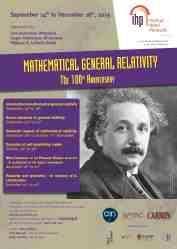
++++++ POSTER OF THE CONFERENCE +++++++
FUNDING
Agence Nationale de la Recherche Project 23-CE40-0010-02 : Einstein constraints: past, present, and future. Investigators: Erwann Delay (Avignon), Romain Gicquaud (IDP, Tours), and Philippe G. LeFloch
European Network MSCA Staff Exchange Project 101131233 : Einstein gravity and nonlinear waves
LUX, Observatoire de Paris and IMB, Université de Bourgogne Europe
… Departure from IHP at the end of the conference…


TITLE and ABSTRACT
Xavier BEKAERT
BMS particles at null infinity
Abstract. Generic unitary irreducible representations (UIRs) of the Bondi-Metzner-Sachs (BMS) group are considered. They are shown to describe quantum superpositions of (Poincaré) particles propagating on inequivalent gravity vacua. This follows from reconsidering McCarthy’s classification of BMS group UIRs through a unique, Lorentz-invariant but non-linear, decomposition of supermomenta into hard and soft pieces.
Laura BERNARD
Gravitational wave tests of generic EFT-inspired theories of gravity
Abstract. Current agnostic tests of gravity with gravitational waves are plagued by a lack of realistic deviations, making it difficult to interpret such detections with respect to specific theories. In this talk, I present a dictionary that identifies the scaling of deviations with the objects’ masses and the leading order post-Newtonian corrections in generic theories constructed through an Effective Field Theory approach based on curvature. In particular, I will demonstrate that a vast set of theories only deviates from General Relativity beginning at a relatively high order. I will also clarify some subtleties of the application of the PN-EFT formalism to higher-curvature EFT theories.
Jean-Pierre BOURGUIGNON (Nicolaas Kuiper Honorary Professor at IHÉS)
Abstract. In the middle of the 20th century, some major actors have succeeded in putting Differential Geometry much more centre stage than it used to be: Élie Cartan, Chern Shiing-Shen, Isadore M. Singer, Sir Michael Atiyah, Eugenio Calabi and of course André Lichnerowicz. This process had a lot to do with the development of new concepts and the appropriation for the field of new tools coming in particular from Analysis and Topology. In almost all cases Lichnérowicz played a key role through research articles and well appreciated books. The purpose of this lecture is two-fold: first, to describe this transformation with an emphasis on some issues to which Lichnerowics gave a lot of attention; second, to highlight some of the interactions I had with him with very clear, friendly and rewarding messages.
Erwann DELAY
Two remarkable differential operators acting on symmetric two-tensors
Abstract. On a Riemannian manifold of dimension three or higher, we introduce two differential operators acting on (fields of) trace-free symmetric 2-tensors. The first, a second-order operator, is a conformally covariant operator, similar to the Yamabe Laplacian on functions. It can be used to test the stability of certain Einstein metrics. The second, a fourth-order operator, acts as a machine for TT-tensors (symmetric 2-tensors that are both trace-free and divergence-free) on Einstein manifolds, as it allows any trace-free symmetric 2-tensor to be transformed into a TT-tensor, with many such tensors being obtained in this way. This operator can also be used to approximate a less regular TT-tensor by a smooth TT-tensor. On a Ricci-flat manifold, the restriction of these two operators to TT-tensors corresponds to the Lichnerowicz Laplacian and its square.
Gustavo DOTTI
Obstructions for trapped submanifolds
Abstract. We introduce the concept of k−future convex spacelike/null hypersurface Σ in an n + 1 dimensional spacetime and prove that no k−dimensional trapped submanifold can be tangent to Σ from its future side. As a consequence, k-dimensional closed trapped submanifolds cannot be found in open spacetime regions foliated by such hypersurfaces. In gravitational collapse scenarios, specific hypersurfaces of this kind act as past barriers for trapped submanifolds. Examples will be given of (3+1) spacetime regions containing trapped loops (k = 1) but no closed trapped surfaces (k = 2) and of how trapped loops could be used as an early indicator of black hole formation in numerical relativity.
Alberto FARINA
Abstract. We consider solutions to critical and sub-critical semilinear elliptic PDEs on complete, noncompact Riemannian manifolds and study their classification as well as the effect of their presence on the underlying manifold. When the Ricci curvature is non-negative, we prove both the classification of positive solutions to the critical equation and the rigidity for the ambient manifold. The same results are established for solutions to the Liouville equation on Riemannian surfaces. Our results are obtained via an appropriate P-function whose constancy implies the classification of both the solutions and the underlying manifold.
Paul GAUDUCHON
On a class of gravitational instantons
Abstract. A Kähler metric is called extremal if its scalar curvature is a Killing potential, i.e. is the moment relative to the Kähler form of a Hamiltonian Killing vector field; it is called toric extremal if the latter belongs to a maximal, effective Hamiltonian toric action preserving the whole Kähler structure. The presence of such a Kähler structure in the conformal class of a class of four-dimensional gravitational instantons of ALF type, including the Euclidean version of well-known Lorentzian spaces, as well as the one-parameter family of instantons discovered in 2011 by Yu Che and Edward Teo, plays a prominent role in its eventual complete classification, including a new description of the Chen–Teo instantons. This is a joint work with Olivier Biquard.
Yuxin GE
Asymptotically hyperbolic Einstein manifolds in dimension four
Abstract. Given a closed Riemannian manifold of dimension three, when will we fill in an asymptotically hyperbolic Einstein manifold of dimension 4 such that its conformal infinity is the above Riemannian metric? This problem is motivated by the correspondance AdS/CFT in quantum gravity proposed by Maldacena in 1998 et comes also from the study of the structure of asymptotically hyperbolic Einstein manifolds. In this talk, I will discuss the compactness issue of asymptotically hyperbolic Einstein manifolds in dimension four, that is, how the compactness on conformal infinity leads to the compactness of the compactification of such manifolds under the suitable conditions on the topology and on some conformal invariants. As an application, I will discuss some recent progress on the existence result.
Romain GICQUAUD
The conformal method is not conformal
Abstract. The conformal method and its variants have long been among the most effective tools for constructing solutions to the Einstein constraint equations. In this talk, I will briefly review the method and its key achievements in generating large classes of initial data. I will then present recent results showing that the conformal method is not conformally covariant. This is an undesirable feature, which I will illustrate through explicit analytic constructions and numerical evidence.
Yannick HERFRAY
Gravitational S-matrix, infrared divergences and BMS representations
Abstract. In recent years, it has been demonstrated that asymptotic symmetries of gravity (the so called BMS group) constrain the gravitational S-matrix. In particular, infrared divergences of the gravitational S-matrix are now understood to arise from to the impossibility of the usual Fock space of massless particles to ensure the conservation of the BMS charges. I will review these results taking the original perspective of representation theory. It is indeed natural to conjecture that asymptotic states suited for an infrared finite S-matrix should be unitary representations of the BMS group and thus BMS particles, rather than the usual Poincaré particles of Wigner. In a recent work with X. Bekaert and L. Donnay we constructed explicitly such BMS particles; this talk aims to serve as an introduction to X. Bekaert’s talk.
Emmanuel HUMBERT
Conformal eigenvalues of GJMS operators
Abstract. I will present recent results obtained in collaboration with R. Petrides and B. Premoselli. Our study focuses on the minimum (maximum) of the positive (negative) eigenvalues of the GJMS operator, considering metrics of volume one within a conformal class on a compact manifold. Specifically, we investigate the existence (or non-existence) of extremizers and explore their properties. This work generalizes previous results, extending the analysis of the second eigenvalue and the Yamabe operator to arbitrary orders and to GJMS operators.
Yvette KOSMANN-SCHWARZBACH
A portrait of Lichnerowicz (text here)
Abstract. I shall outline a portrait of André Lichnerowicz (1915-1998). Professor at the Collège de France, he was a great mathematician who published in mathematical physics, as well as in differential geometry, from his thesis in 1939 until his death. He was a reformer of the teaching of mathematics in France as well as a philosopher. I shall underline his collaboration with Moshé Flato when they introduced the theory of deformation quantization. He supervised numerous students, many of whom went on to become well-known mathematicians. Ten years after his death, the Lichnerowicz prize was instituted to honor young researchers in Poisson geometry, a field he pioneered in his groundbreaking article of 1977.
David LANGLOIS
Modified gravity and black holes
Abstract. This talk will present a very broad family of scalar-tensor theories of gravity that contains a single scalar degree of freedom, in addition to the usual tensor modes. These theories, known as Degenerate Higher-Order Scalar-Tensor (DHOST) theories, include and extend traditional scalar-tensor theories as well as the so-called Horndeski theories. I will then discuss black hole solutions in these theories and their perturbations, illustrated by some particular cases.
Bruno LE FLOCH
Optimal localization for the Einstein constraints
Abstract. In 2014, Carlotto and Schoen constructed initial data sets that solve the vacuum Einstein constraints and that interpolate between any asymptotically-flat vacuum solution in a cone and Euclidean space outside a wider cone. Starting from a naive interpolation (g,K) of the two solutions to be glued, they corrected it to an exact solution that is asymptotic flat with a power-law decay slightly worse than that of (g,K). With Philippe G. LeFloch, we reached an optimal version of their gravitational shielding by proving estimates whose power-law decay is controlled by the accuracy with which (g,K) solves the constraints, even beyond harmonic decay (namely the decay rate of black hole metrics). At the harmonic decay rate, we encounter corrections in the kernel of asymptotic operators built from the linearized constraints. Our work allows for very slow decay of the metrics, in which case one must define the relative ADM energy and momentum of a pair of sufficiently close initial data sets.
Marc MARS
Characterizations results of Kerr-de Sitter in any dimension
Abstract. The Kerr-de Sitter metric in arbitrary dimension was proposed by Gibbons et al. as a generalization the four dimensional Kerr-de Sitter metric obtained by Carter. While the role of particular cases of Kerr-de Sitter (such as Kerr-Myers-Perry, Schwarzschild-Tangherlini, de Sitter or Minkowski) certainly play a pivotal role in gravity, the role of Kerr-de Sitter is far less clear. In this talk I will explore local geometric properties that characterize the Kerr-de Sitter metric in arbitrary dimension. The main tool will be to analyze its asymptotic data at null infinity. In particular, I will show that the simplest (non-trivial) asymptotic data gives rise to a class of spacetimes called Kerr-de Sitter-like and I will identify what makes Kerr-de Sitter special within this class. Based on this, I will present various characterization properties of the Kerr-de Sitter-like metrics in arbitrary dimension.
Filipe MENA
Initial value problem in modified theories of gravity
Abstract. The question we address in this talk is how can one formulate a (locally) well-posed initial value problem in modified theories of gravity. We review recent results including scalar-tensor and Einstein-Cartan theories before focusing on a spherically evolution problem in f(R) theory.
Jérémie SZEFTEL
The nonlinear stability of Kerr for small angular momentum
Abstract. I will introduce the celebrated black hole stability conjecture according to which the Kerr family of metrics are stable as solutions to the Einstein vacuum equations of general relativity. I will then discuss the history of this problem, including a recent work on the resolution of the black hole stability conjecture for small angular momentum.
Alex VAÑO-VIÑUALES
Numerical hyperboloidal compactification: waves on FLRW and Einstein equations
Abstract. Both parts of this talk involve numerical simulations on compactified hyperboloidal slices reaching future null infinity. The first part, presenting joint work with Flavio Rossetti, focuses on the asymptotic decay of the linear wave equation on flat and hyperbolic FLRW spacetimes with a time-dependent scale factor. I will describe the setup, which allows us to recover decay rates obtained from evolutions on usual truncated Cauchy slices, and also consider solutions of a non-linear wave with self-interactions. The second part will summarize my approach using conformal compactification to free hyperboloidal evolutions of the Einstein equations. I will describe the main ingredients, present relevant results, and update on the current status towards 3D evolutions.
Mikhail VOLKOV
Black holes with electroweak hair
Abstract. We construct static and axially symmetric magnetically charged hairy black holes in the gravity-coupled Weinberg-Salam theory. Large black holes merge with the Reissner-Nordstr\”om (RN) family, while the small ones are extremal and support a hair in the form of a ring-shaped electroweak condensate carrying superconducting W-currents and up to 22% of the total magnetic charge. The extremal solutions are asymptotically RN, with a mass below the total charge, due to the negative Zeeman energy of the condensate interacting with the black hole magnetic field. Therefore, they cannot decay into RN black holes. As their charge increases, they show a phase transition, when the horizon symmetry changes from spherical to oblate. At this point, they have the mass typical for planetary size black holes of which about 11% are stored in the hair. Being obtained within a well-tested theory, our solutions are expected to be physically relevant.
CONTRAINTES D’EINSTEIN:
passé, présent et futur
EINSTEIN CONSTRAINTS: past, present, and future
Erwann DELAY (Avignon), Philippe G. LeFLOCH (Sorbonne), Romain GICQUAUD (Tours)
Research project ANR-23-CE40-0010-02 (Einstein-PPF)
funded by the Agence Nationale de la Recherche (ANR)
MEMBRES / MEMBERS
Xavier Bekaert (Tours), Erwann Delay (Avignon), Alberto Farina (Amiens), Yuxin Ge (Toulouse), Romain Gicquaud (Tours), Eric Gourgoulhon (Meudon), Emmanuel Hebey (Cergy-Pontoise), Marc Henneaux (Collège de France), Marc Herzlich (Montpelier), Emmanuel Humbert (Tours), Paul Laurain (Sorbonne, IMJ), Bruno Le Floch (Sorbonne, LPTHE), Philippe LeFloch (Sorbonne, JLL), Simon Raulot (Rouen), Emmanuel Trélat (Sorbonne, JLL), Caterina Vâlcu (Créteil)
POSTDOCS and Ph.D. STUDENTS
— Fellowship in Avignon : now closed
— Fellowship in Tours : currently open Apply HERE
— Fellowship in Paris : to be open in 2026. Email: contact [AT] philippelefloch [DOT] org
ACTIVITÉS RECENTES / RECENT ACTIVITIES
— 27 au 29 mai 2024: Rencontre à Avignon, organisée par Erwann Delay
— 11 au 13 juin 2025 : Conférence à Paris organisée par Philippe LeFloch, dans le cadre de la Conférence Lichnerowicz 2025
— Rencontres en ligne organisées tous les semestres
Alberto FARINA (Rouen)
Résultats de classification, théorèmes de rigidité et EDPs semi-linéaires sur les variétés riemanniennes : une approche par p-fonction
Résumé. Nous considérons les solutions d’équations elliptiques semi-linéaires critiques et sous-critiques sur des variétés riemanniennes complètes, non compactes et étudions leur classification ainsi que l’effet de leur présence sur la variété sous-jacente. Lorsque la courbure de Ricci est non-négative, nous prouvons à la fois la classification des solutions positives à l’équation critique et la rigidité de la variété ambiante. Les mêmes résultats sont établis pour les solutions de l’équation de Liouville sur les surfaces riemanniennes. Nos résultats sont obtenus en montrant qu’une fonction auxiliaire appropriée (P-fonction) est constante. Ceci implique la classification à la fois des solutions et de la variété sous-jacente. L’analyse effectuée sur la fonction P permet également de classifier les solutions non-négatives d’équations sous-critiques sur les variétés qui vérifient une inégalité de Sobolev et une condition d’intégrabilité sur la partie négative de la courbure de Ricci.
Romain GICQUAUD (Tours)
Sur le “mass aspect” des variétés asymptotiquement hyperboliques
Abstract. Il existe deux définitions de la masse pour les variétés asymptotiquement hyperboliques. La première due à P. Chrusciel et M. Herzlich est un analogue de la définition ADM classique, i.e. une intégrale sur une sphère de rayon infini d’une certaine quantité construite à partir de la métrique et de ses dérivées premières. Mais il existe une autre définition due à M.-T. Wang qui décrit la masse comme l’intégrale du premier terme non nul dans l’expansion asymptotique de la métrique (communément appelé mass aspect). Je montrerai que ce mass aspect admet une définition dans un cadre de régularité faible analogue à celui de Chrusciel-Herzlich et qu’il possède de bonne propriétés de covariance sous les changements de carte à l’infini. Ce travail est en collaboration avec Anna Sakovich (Université d’Uppsala).
Klaus KRÖNCKE (Stockholm)
Dynamical stability and instability of Poincaré Einstein manifolds
Abstract. We prove dynamical stability and instability theorems for Poincaré-Einstein metrics under the Ricci flow. Our key tool is a variant of the expander entropy for asymptotically hyperbolic manifolds, which Dahl, McCormick and I established in a recent article. It allows us to characterize stability and instability in terms of a local positive mass theorem and in terms of volume comparison for nearby metrics. This is joint work with Louis Yudowitz.
Benjamin MECO (Uppsala)
The generalized Jang equation in the asymptotically anti-de Sitter setting and possible applications
Abstract. The generalized Jang equation was introduced by Bray and Khuri in an attempt to prove the Penrose inequality in the setting of asymptotically Euclidean initial data sets for the Einstein equations. Since then it has appeared in a number of arguments allowing to prove geometric inequalities for initial data sets by reducing them to known inequalities for Riemannian manifolds provided that a certain geometrically motivated system of equations can be solved. We will present a novel argument along these lines that could potentially lead to a proof of the positive mass theorem for asymptotically hyperbolic initial data sets modeling constant time slices of asymptotically anti-de Sitter spacetimes. Furthermore, we will show how to construct a geometric solution of the generalized Jang equation in this setting, in the case when the dimension is less than 8 and for very general asymptotics, using methods from geometric measure theory.
Pieralberto SICBALDI (Granada)
A Schiffer-type problem in annuli and applications to Euler flows
Abstract. If on a smooth bounded domain of the plane there is a (non-constant) Neumann Laplace eigenfunction that is locally constant on the boundary, must the domain be a disk or an annulus? This question can be understood as a weaker analog of the well known Schiffer conjecture. In fact, here the eigenfunction is allowed to take a different constant value on each connected component of the boundary. Many of the known rigidity properties of the original Schiffer problem are essentially preserved. In this talk I will show that the answer to such question is negative by constructing
a family of nontrivial doubly connected domains with the above property. Furthermore, I will show that this implies the existence of continuous, compactly supported stationary weak solutions to the 2D incompressible Euler equations which are not locally radial. This talk is based on a joint work with A. Enciso, A. J. Fernández and D. Ruiz.
Caterina VÂLCU (Villetaneuse)
Solving initial data for Kaluza-Klein spacetimes
Abstract. We study the constraint equations for Einstein equations on manifolds of the form Rn+1×Tm, where Tm is a flat m-dimensional torus. Spacetimes with compact directions were introduced almost a century ago by Theodor Kaluza and Oskar Klein as an early attempt of unifying electromagnetism and general relativity in a simple, elegant way. The aim of this article is to construct initial data for the Einstein equations on manifolds of the form Rn+1× Tm, which are asymptotically flat at infinity, without assuming any symmetry condition in the compact direction. We use the conformal method to reduce the constraint equations to a system of elliptic equation and work in the near CMC (constant mean curvature) regime. The main new feature of the proof is the introduction of new weighted Sobolev spaces, adapted to the inversion of the Laplacian on product manifolds. Classical linear elliptic results need to rigorously proved in this new setting. This is joint work with Cécile Huneau.
MAIN OBJECTIVES OF THIS PROJECT
Parametrization of initial data sets for the Einstein equations. The project focuses on the global geometry of Riemannian manifolds satisfying Einstein constraints arising in general relativity. In other words, we are interested in the geometric and analytic properties of initial data sets, consisting of a spacelike hypersurface (representing a slice of “present” time) in a spacetime satisfying Einstein’s field equations (possibly coupled to matter fields). Among our main objectives, we will seek a parametrization of “all” such hypersurfaces and describe their global geometric and asymptotic properties, for instance their behavior at spacelike infinity or in the vicinity of gravitational singularities. We intend to encompass a broad variety of geometric setups, including compact as well as non-compact manifolds with, for instance, asymptotically Euclidian or asymptotically hyperbolic ends. Interestingly, many central concepts of geometry and general relativity play a role.
Seek a unification of techniques and results. Our project takes its roots in our past, namely Lichnerowicz’s pioneering work on the so-called Conformal Method, later generalized by many researchers (see below). The Project also builds upon present developments on the so-called Variational Method, first proposed by Corvino and Schoen. We also intend to contribute to shape the future in this field and seek a unification of the results and methods currently available on Einstein’s constraint equations. Despite these old and new advances on the subject, including significant contributions by members of this Project, the literature on Einstein constraints remains a collection of dispersed results and ad-hoc techniques, and still offers many outstanding open problems: definition of asymptotic invariants, rigidity properties, asymptotic behaviors, etc.
Existing and new directions. To the opinion of the members of this Project, in past years this field has not received sufficient attention (nor funding), and given all recent developments (on the evolution problem for the Einstein equations, on the study of curvature invariants in Riemann geometry, and in numerical relativity) the time is now ripe to fill this gap and push the research in geometric analysis in the proposed directions. This research Project should also open up new directions on modified theories of gravity (such as the f(R,T) theory and Kaluza-Klein theory) and numerical relativity.
RECENT CONTRIBUTIONS by the members of the project
(To be completed)

 Mathematical general relativity, compressible fluids, and more