You are currently browsing the tag archive for the ‘laboratoire-jacques-louis-lions’ tag.
_____________________________________________________________________________________________________________
Seminar on Mathematical General Relativity
Laboratoire Jacques-Louis Lions
Sorbonne Université
Organizers
Cécile Huneau (i) Philippe G. LeFloch (ii)
Jacques Smulevici (ii) Jérémie Szeftel (ii)
(i) ENS Paris (ii) Sorbonne Université, Paris
Academic year 2025–2026
Thursday April 16, 2026
lecture room 15-16–309 (Jussieu)
14h Marios PETROPOULOS (E. Polytechnique, Palaiseau)
Carrollian geometry and application to gravitational dynamics
Abstract. The Poincaré group is at the heart of Einstein’s description of spacetime. Its non-relativistic limit, the Galilean group, is adapted to physics at velocities that are small compared with the speed of light. There is another limit, called the Carrollian limit, obtained formally as a zero-speed-of-light limit. Despite its exotic nature, this limit has found a vast field of applications in the study of the asymptotic symmetries of certain types of spacetimes, in the description of the horizons of black holes, and in the formulation of the ultra-relativistic limit of fluids. In this presentation, I will provide an overview of the fundamental principles of Carrollian geometry and explain how these can be used to derive the Bondi flux balance equations on the null boundary of asymptotically flat spacetimes.
15h30 Jingbo WAN (LJLL, Sorbonne)
Title TBA soon
Abstract. TBA soon
Thursday March 19, 2026
lecture room 15-16–309 (Jussieu)
14h Xuantao CHEN (LJLL, Sorbonne)
Solving the constraint equation for general free data
Abstract. We revisit the problem of solving the Einstein constraint equations in vacuum by a new method, which allows us to prescribe four scalar quantities, representing the full dynamical degrees of freedom of the constraint system. We show that once appropriate gauge conditions have been chosen and four scalars freely specified (modulo modes), we can rewrite the constraint equations as a well-posed system of coupled transport and elliptic equations on two-spheres, which we solve by an iteration procedure. Our method provides a large class of exterior solutions of the constraint equations that can be matched to given interior solutions, according to the existing gluing techniques. This is joint work with S. Klainerman.
15h30 Georgios MOSCHIDIS (EPFL, Lausanne)
Naked singularities with finite blue-shift for the Einstein–massless Vlasov system
Abstract. In his celebrated proof of the weak cosmic censorship conjecture for the spherically symmetric Einstein-scalar field system, Christodoulou exploited the following property of that specific matter model: Naked singularities, when they arise, exhibit infinite blue-shift along the null geodesics terminating at the singularity. This behaviour is consistent with self-similarity: Even for more general spherically symmetric matter models, it can be shown that self-similar naked singularities must exhibit infinite blue-shift. Whether, for these more general models, all naked singularities have the infinite blue shift property (and hence are potentially subject to an instability mechanism analogous to that introduced by Christodoulou) still remains an open question. In this talk, I will present the construction of a spherically symmetric solution to the Einstein-massless Vlasov system which contains a locally naked singularity with finite total blue-shift along its past null cone. The initial data giving rise to this solution have limited differentiability, but belong to a regularity class above the scale invariant threshold.
Thursday February 19, 2026
lecture room 15-25-322 (nouvelle salle)
14h Jack BORTHWICK (IMJ, Sorbonne)
Geometry at time-like infinity and massive fields
Abstract. This talk explores recent geometric constructions in the setting of projectively compact Ricci-flat Einstein manifolds, with an emphasis on the role of projective geometry. I will discuss how these constructions encode aspects of the geometry at infinity, and present some initial ideas and results on their potential relevance for the analysis of massive classical particle fields a « timelike » infinity.
15h30 Itsvan KADAR (ETH, Zürich)
Matching conditions for scattering solutions of scalar wave equations on extremal black holes
Abstract. The existence of spacetimes describing multiple black holes and their asymptotic properties—such as their late-timebehavior—is an exciting open area of mathematical research. In this talk, I will report on some preliminary steps towards addressing this problem. As a toy model, we study a nonlinear scalar wave equation on a multi–extremal- black-hole spacetime with a prescribed, polynomially decaying, smooth radiation field at null infinity. We construct smooth solutions in the spacetime by identifying appropriate initial data on a spacelike hypersurface inside the black hole regions. This is joint ongoing work with Yannis Angelopoulos.
Thursday December 18, 2025
lecture room 15-25-322 (nouvelle salle)
14h Flavio ROSSETTI (L’Aquila)
Strong cosmic censorship for de Sitter black holes
Abstract. We will discuss modern formulations of the strong cosmic censorship conjecture (SCCC) and possible resolutions supported by rigorous non-linear results for the spherically symmetric Einstein-Maxwell-scalar field system. We will show that the presence of a positive cosmological constant suggests a violation of the SCCC at a fundamental level of regularity. Indeed, the blueshift mechanism occurring at the Cauchy horizon can be counter-balanced by the dispersive effects encoded in the exponential Price law along (cosmological) black hole event horizons. On the other hand, we show that, if non-smooth black hole solutions are allowed, then the aforementioned violations are non-generic in a positive co-dimension sense.
15h30 Gemma HOOD (Leipzig)
A scattering construction for nonlinear wave equations on Kerr-Anti de Sitter spacetimes
Abstract. Given the sharp logarithmic decay of linear waves on the Kerr-AdS black hole (Holzegel, Smulevici, 2013), it is expected that the Kerr-AdS spacetime is unstable as a solution of the Einstein vacuum equations. However, the scattering construction presented here for exponentially decaying nonlinear waves on a fixed Kerr-AdS background serves as a first step to confronting the scattering problem for the full Einstein system. In this context, one may hope to derive a class of perturbations of Kerr-AdS which remain ‘close’ and dissipate sufficiently fast.
Thursday November 27, 2025
lecture room 15-25-101 (Jussieu)
14h Mahdi HAGHSHENAS (Imperial College, London)
Boundedness and decay of waves on decelerated FLRW spacetimes
Abstract. After outlining the stability problem for Friedmann–Lemaître–Robertson–Walker (FLRW) spacetimes, we study the wave equation —as a proxy for the Einstein equations— on decelerated FLRW spacetimes with non-compact, flat spatial sections. We demonstrate how dispersion and expansion affect the long-time behavior of waves. In particular, we present uniform energy bounds and integrated local energy decay estimates across the full decelerated expansion range. Furthermore, we describe a hierarchy of r-weighted energy estimates, in the spirit of the Dafermos–Rodnianski method, which lead to energy decay estimates.
15h30 Pau FIGUERAS (Queen Mary, London)
The initial value problem for higher derivative theories of gravity
Abstract. General relativity can be thought of as a low energy (classical) effective field theory (EFT) of gravity. As such, on general grounds, it is expected that it should receive higher derivative corrections. However, the equations of motion of such higher derivative theories are higher than second order; in particular, they have more than two time derivatives and hence they are plagued with runaway solutions that are unphysical. Furthermore, being higher than second order, it is not clear how to formulate the initial value problem and thus extract their predictions consistently with the EFT expansion. In this talk, I will review the various approaches to this old problem and I will present our recent proposal called “regularization”. As I will show, regularisation allows to formulate the initial value problem for a very general class of higher derivative theories in a manifestly well-posed way, it is covariant and it does not require any fine tuning.
Thursday October 16, 2025
lecture room 15-16-309 (Jussieu)
14h Ludovic SOUETRE (Sorbonne)
Geometric reflective boundary conditions for asymptotically Anti-de Sitter spaces
Abstract. Modeled on the Anti-de Sitter space, asymptotically Anti-de Sitter spaces are defined as Lorentzian manifolds that possess a timelike conformal boundary. As a result, they are not globally hyperbolic. In order to find such spaces that also solve the Einstein equations (with a negative cosmological constant), it is therefore necessary to consider the Cauchy problem as an initial boundary value problem. In this talk, I will discuss the geometric boundary conditions that can be prescribed on the conformal boundary to ensure local existence and uniqueness of solutions in dimension 4. The first one, introduced by Friedrich in his pioneering 1995 work, consists in imposing the boundary conformal class and is known as the Dirichlet boundary condition. The second is a new family of geometric reflective boundary conditions involving both the boundary conformal class and the boundary stress-energy tensor. It can be regarded as the homogeneous Robin boundary conditions.
15h30 Taoran HE (IHES)
Abstract. I will present our recent work on the stability of Kasner solutions for the Einstein-Maxwell-scalar field-Vlasov system in 1+3 dimensions. This system incorporates gravity, electromagnetic, weak and strong interactions for the initial stage of our universe. The inclusion of the Vlasov field introduces several new challenges. By observing detailed mathematical structures and designing new delicate arguments, we identify a new strong sub-critical regime and prove the nonlinear stability with Kasner exponents lying in this entire regime. Our results extend the work of Fournodavlos, Rodnianski, and Speck from the Einstein-scalar field system to the physically more complex system with the Vlasov field. This is joint work with Xinliang An and Dawei Shen.
_____________________________________________________________________________________________________________
Seminar on Mathematical General Relativity
Laboratoire Jacques-Louis Lions
Sorbonne Université
Organizers
Cécile Huneau (i) Philippe G. LeFloch (ii)
Jacques Smulevici (ii) Jérémie Szeftel (ii)
(i) Ecole Polytechnique, Palaiseau
(ii) Sorbonne Université, Paris
Academic year 2024–2025
Thursday July 3, 2025
lecture room 15-16-309 (Jussieu)
14h Armand Coudray (Franche-Comté)
Peeling-off behavior of the wave equation in the Vaidya spacetime
Abstract. I will discuss the asymptotic regularity of the wave equation in Vaidya spacetime, which is a spherical solution to Einstein’s equations in which the metric depends on time. In other words, the aim is to prove that the asymptotic regularity of the field is equivalent to the regularity of the initial data. The analysis is based on two methods. First, I will characterize the asymptotic behavior of the wave equation using the conformal construction developed by Penrose in the 1960’s. Secondly, I will derive the equivalence between the asymptotic and initial data using energy estimates. In view of the structure of the conformal boundary of the black hole solution’s, a particular focus is put on the regularity at spacelike infinity, a singularity of the boundary. Finally, I will prove that the class of initial data ensuring the field’s regularity on the boundary is the same as the one in flat spacetime.
15h30 Tony Salvi (Palaiseau)
Semi-classical limit for the Klein-Gordon and Klein-Gordon-Maxwell equations
Abstract. Quantum mechanics is well-approximated by classical physics when the Planck constant is very small, i.e. in the semi-classical limit. Typically, one studies an observable associated with a particle, such as its momentum or position, and shows that its dynamics is given by classical dynamics at first order, with corrections of order of Planck’s constant. In this talk, I will present the concept of semi-classical limit, the standard mathematical results known for non-relativistic quantum mechanics, and my results concerning the semi-classical limit in the context of relativistic quantum mechanics. I will show how to adapt the modulated energy method that was developed for the Schrödinger equation, to the Klein- Gordon and Klein-Gordon-Maxwell equations, and how to recover relativistic mechanics (instead of classical mechanics) in the semi-classical limit.
Thursday March 20, 2025
lecture room 15-16-309 (Jussieu)
14h Hans Ringström (Stockholm)
Formation of quiescent big bang singularities
Abstract. A basic question in general relativity is if big bang singularities appear naturally in solutions to Einstein’s equations. In the early days of general relativity, explicit solutions with such singularities were found. Later, the singularity theorem of Hawking was demonstrated. It provides an indication that big bang singularities should appear naturally but does not say much about their nature. Recently, many results concerning stable big bang formation have appeared. Most of the results concern stability of spatially homogeneous and isotropic solutions. However, a recent result of Fournodavlos, Rodnianski and Speck covers the full regime in which stability is to be expected. On the other hand, it is restricted to the stability of spatially homogeneous and spatially flat solutions. In this talk, I will present a new result (joint work with Hans Oude, Groeniger and Oliver Petersen) in which we identify a general condition on initial data ensuring big bang formation. The solutions need, in this case, not be close to symmetric background solutions. Moreover, the result reproduces previous results in the Einstein-scalar field and Einstein-vacuum settings. Finally, the result is in the Einstein-non-linear scalar field setting, and therefore yields future and past global non-linear stability of large classes of spatially locally homogeneous solutions.
15h30 Arthur Touati (Bordeaux)
Spacelike initial data for black hole stability
Abstract. I will present a joint work with Allen Juntao Fang and Jérémie Szeftel on the resolution of the constraint equations in the context of black hole stability. After having presented the motivations coming from the evolution problem and reviewing the literature on the constraint equations, I will show how a bit of Fredholm theory and the careful construction of a boundary condition for the elliptic system can help avoiding linear obstructions (the famous KIDS) and thus produce initial black hole perturbations with arbitrary decay.
Thursday March 13, 2025
lecture room 15-16-309 (Jussieu)
14h Sam Collingbourne (Edinburgh)
The Gregory–Laflamme Instability of the 5D Schwarzschild black string exterior
Abstract. Gregory–Laflamme type instabilities seem to plague black holes in dimensions greater than 4. Gregory–Laflamme instabilities are mode instabilities at the level of the linearised Einstein vacuum equation and have been identified heuristically and numerically for black holes that have an event horizon that has one direction that is large compared to all others. In this talk, I will discuss a direct rigorous mathematical proof of the Gregory–Laflamme instability for the 5D Schwarzschild black string. Under a choice of ansatz for the perturbation and a gauge choice, the linearised vacuum Einstein equation can be reduced to a Schrödinger eigenvalue equation to which an energy functional is assigned. It is then shown by direct variational methods that the lowest eigenfunction gives rise to an exponentially growing mode solution which has admissible behaviour at the future event horizon and spacelike infinity in harmonic/transverse-traceless gauge.
15h30 Allen Fang (Munster, Germany)
Wave behavior in the vanishing cosmological constant limit
Abstract. Black hole stability is a central topic in mathematical relativity that has seen numerous advancements in recent years. Both the Kerr-de Sitter and the Kerr black hole spacetimes have been proven to be stable in the slowly-rotating regime. However, the methods used have been markedly different, as well as the decay rates proven. Perturbations of Kerr-de Sitter converge exponentially back to a nearby Kerr-de Sitter black hole, while perturbations of Kerr only converge polynomially back to the family. In this talk, I will speak about wave behavior that is uniform in the cosmological constant by considering solutions to the model Regge-Wheeler equations in Kerr(-de Sitter). The main point is a careful handling of the relevant estimates on the region of the spacetime far from the black hole. This provides a first step into understanding the uniform (in the cosmological constant) stability of black hole spacetimes. This is joint work with Jeremie Szeftel and Arthur Touati.
Thursday January 23, 2025
lecture room 15-16-309 (Jussieu)
14h Volker Schlue (Melbourne)
Nonlinear stability of the expanding region of Kerr de Sitter spacetimes
Abstract. The topic of this lecture is the global nonlinear stability problem for Kerr de Sitter spacetimes. Following a discussion of the results of P Hintz and A Vasy on the nonlinear stability of the stationary black hole exterior, and those of H Friedrich for de Sitter spacetimes, we turn to the so-called cosmological, or expanding region of Kerr de Sitter spacetimes. I will present recent work with G Fournodavlos, which establishes global existence and asymptotics in this region, compatible with de Sitter like degrees of freedom. Our work can be combined with the results of P Hintz and A Vasy, to yield the global nonlinear stability of Kerr de Sitter spacetimes, featuring both aspects of an asymptotic and orbital stability result.
15h30 Sebastian Gurriaran (Sorbonne)
On the linear instability of the Kerr Cauchy horizon
Abstract. I will describe a recent work on the linear instability of the Kerr Cauchy horizon, first proven by Sbierski. In the context of a linearized gravitational perturbation of a Kerr black hole, I will present the precise asymptotics of the spin +2 Teukolsky scalar in the interior region of the black hole, proving its exponential blow-up on the Cauchy horizon, as well as an oscillatory behavior caused by the non-zero angular momentum of the black hole. The result supports Strong Cosmic Censorship in Kerr spacetimes. I will give a sketch of the proof, which is done purely in physical space and which is based on Price’s law results in Kerr proven by Ma and Zhang.
Thursday December 19, 2024
lecture room 15-16-309 (Jussieu)
14h Filip Ficek (Vienna)
Time-periodic solutions to nonlinear wave equations
Abstract. I will discuss time-periodic solutions for nonlinear wave equations on an interval with Dirichlet boundary conditions. The classic works prove the existence of small amplitude periodic solutions with frequencies belonging to nowhere dense sets. I will show numerical evidences suggesting that these gaps in frequencies are filled with large amplitude solutions. This leads to intricate bifurcation structures forming fractal-like patterns. I will propose a systematic approach of analyzing these complex structures. This talk is based on joint work with Maciej Maliborski.
15h30 Robert Sansom (Queen Mary, London)
The null gluing problem for the Einstein equations
Abstract. The null gluing problem for the Einstein equations is the problem of matching two solutions of the Einstein equations along a null hypersurface. I will present a solution to the third-order null gluing problem, that is, where up to third-order derivatives of the metric are to be glued. In the regime where the characteristic data is close to Minkowski data, this third-order null gluing problem is solvable up to a 20-dimensional space of obstructions. The obstructions correspond to 20 linearly conserved quantities: 10 of which are already present in the second-order null gluing problem analyzed by Aretakis-Czimek-Rodnianski, and 10 are novel obstructions. The 10 novel obstructions are linearly conserved charges calculated from third-order derivatives of the metric.
Thursday November 21, 2024
lecture room 15-16–201 (Jussieu)
14h Louie Bernhardt (Melbourne)
Scattering of linear waves on the expanding region of Schwarzschild-de Sitter
Abstract. I will discuss several new results relating to the linear wave equation on Schwarzschild-de Sitter spacetime. We establish a finite-order asymptotic expansion for solutions in the expanding region. This is accomplished by introducing new higher-order weighted energy estimates that capture the higher-order asymptotics of solutions. We also prove the existence and uniqueness of scattering solutions from data at infinity which possess asymptotics consistent with the forward problem. I will explain how this is achieved via the construction of approximate solutions that capture the desired asymptotics, as well as a new weighted energy estimate suitable for the backward problem. Time permitting, I will discuss how these results generalise to a class of expanding spacetimes which do not necessarily converge back to Schwarzschild-de Sitter at infinity.
15h30 Warren Li (Princeton)
BKL bounces outside homogeneity
Abstract. In the latter half of the 20th century, physicists Belinski, Khalatnikov and Lifshitz (BKL) proposed a general Ansatz for solutions to the Einstein equations possessing a (spacelike) singularity. They suggest that, near the singularity, the evolution of the spacetime geometry at different spatial points decouples and is well-approximated by a system of autonomous nonlinear ODEs, and further that general orbits of these ODEs resemble a (chaotic) cascade of heteroclinic orbits called “BKL bounces”. In this talk, we present recent work verifying the validity of BKL’s heuristics in a large class of symmetric, but spatially inhomogeneous, spacetimes which exhibit (up to one) BKL bounce on causal curves reaching the singularity. In particular, we prove AVTD behavior (i.e. decoupling) even in the presence of inhomogeneous BKL bounces. The proof uses nonlinear ODE analysis coupled to hyperbolic energy estimates, and one hopes our methods may be applied more generally.
Thursday October 17, 2024
lecture room 15-16-309 (Jussieu)
14h Liam Urban (Vienna)
On the past maximal development of near-FLRW data for the Einstein scalar-field Vlasov system
Abstract. I will discuss recent results on the past nonlinear stability of FLRW solutions to the Einstein scalar-field Vlasov system in three and four spacetime dimensions without symmetry assumptions, the latter based on joint work with David Fajman. Such near-FLRW solutions are shown to be asymptotically velocity term dominated toward the past, resulting in a quiescent Big Bang singularity. The Vlasov distribution, however, becomes highly anisotropic towards the Big Bang singularity, concentrating in preferred momentum eigen-directions associated with the second fundamental form. To ensure that the scalar field sufficiently mitigates this behavior, one crucially exploits a scaling hierarchy between horizontal and vertical derivatives in the expansion normalized Vlasov equation. In 3+1 dimensions, this is combined with Bel-Robinson variable approach to control the quiescent variables, and similar ideas apply in a significantly simpler proof in 2+1 dimensions.
15h30 Matthew Schrecker (Bath)
Stability of gravitational collapse
Abstract. In the Newtonian setting, a star is modelled as a spherically symmetric gas obeying the compressible Euler-Poisson system. In certain regimes, smooth initial data may give rise to blow-up solutions, corresponding to the collapse of a star under its own gravity. In recent years, certain families of self-similar gravitational collapse solutions have been rigorously constructed. In this talk, I will first survey some of these constructions, and then present the nonlinear stability of the Larson-Penston solution, which is conjectured in the astrophysical literature to act as a ground state in gravitational collapse. This is based on joint works with Yan Guo, Mahir Hadzic, and Juhi Jang.
_____________________________________________________________________________________________________________
Seminar on Mathematical General Relativity
Laboratoire Jacques-Louis Lions
Sorbonne Université
Organizers
Cécile Huneau (i) Philippe G. LeFloch (ii)
Jacques Smulevici (ii) Jérémie Szeftel (ii)
(i) Ecole Polytechnique, Palaiseau
(ii) Sorbonne Université, Paris
Academic year 2023–2024
Thursday June 13, 2024
lecture room 15-16-309 (Jussieu)
14h Leonhard Kehrberger (Leipzig)
Early-time asymptotics for linearized gravity around Schwarzschild
(The case against smooth null infinity)
Abstract. I will describe recent and upcoming work on the asymptotic behavior of gravitational radiation (solutions to linearised gravity around Schwarzschild) in a neighborhood of spacelike infinity including past and future null infinity in the context of the semi-global scattering problem, where the scattering data are posed on an ingoing null cone emanating from past null infinity and on past null infinity itself. After proving well-posedness for this problem, I will explain how a class of approximate conservation laws can be used to translate the asymptotics of the scattering data into estimates on the semi-global asymptotic expansions near spacelike infinity of the corresponding solutions projected onto fixed angular modes. The summability of these fixed angular mode estimates can then be inferred from a soft statement of persistence of polyhomogeneity, of which I will also sketch a proof. These general methods can, finally, be applied to produce the asymptotics around spacelike infinity for particular choices of data suitable for capturing systems of, say, several infalling masses from the infinite past, confirming earlier heuristic predictions due to Damour and Christodoulou, and resulting in concrete corrections to various popular notions of asymptotic flatness. This talk is based on joint work with Hamed Masaood and Istvan Kadar.
15h30 Toan T. Nguyen (State College)
Landau damping and survival threshold
Abstract. The talk will be devoted to reporting a recent work in collaboration with Daniel Han-Kwan (Nantes) and Frederic Rousset (Orsay) on the linear decay for the relativistic Vlasov-Maxwell system near spatially homogeneous equilibria. Its dynamics at the large time turns out to be extremely rich physically and mathematically, including plasma oscillations, survival threshold, Landau damping at resonances, and phase mixing.
Thursday May 2nd, 2024
lecture room: exceptionally — morning 15-16-201 — afternoon 15-16-309
11h Greg Fournodavlos (Heraklion)
Global stability of cosmological fluids with extreme tilt
Abstract. In cosmology, the equation of state of a perfect fluid is considered to be p = a rho, where a is the squared of the speed of sound. The simplest solution to the Einstein-Euler system, known as FLRW, representing a cosmological fluid, was discovered by Friedmann already in 1922. There is an extensive literature in physics concerning the dynamics of cosmological fluids. However, rigorous mathematical works proving the stability of homogeneous backgrounds are so far restricted to small sound speeds, up to the radiation threshold. Interesting bifurcation phenomena and instabilities are predicted for larger sound speeds. I will discuss joint work with E. Marshall and T. A. Oliynyk proving the global stability of homogeneous solutions with so-called extreme tilt, whose fluid vector field becomes asymptotically null, beyond the radiation case.
14h Marios Apetroaie (Münster)
On the Linear (In)stability of Extremal Reissner-Nordström
Abstract. The Reissner-Nordström spacetime, as a solution to the Einstein-Maxwell equations, has been shown to be linearly stable for the full sub-extremal range, |Q|<M, by Elena Giorgi. We address the aforementioned problem for the extremal case, |Q|=M, which contrary to the subextremal one we show instability results manifesting along the future event horizon of the black hole. In particular, depending on the number of translation invariant derivatives of derived gauge-invariant quantities, we obtain decay, non-decay, and polynomial blow-up estimates asymptotically along the horizon . In this presentation, we motivate the main ideas showing that solutions to the generalized Teukolsky system of positive and negative spin satisfy analogous estimates as well. Stronger and unprecedented instabilities are realised for the negative spin solutions, with one of the extreme curvature component not decaying asymptotically along the event horizon.
Thursday March 28, 2024
lecture room 15-16-309 (Jussieu)
14h Pin Yu (Tsinghua University, Beijing)
Sur la stabilité non-linéaire des ondes de raréfaction multidimensionnelles
Abstract. En 1860, Riemann a introduit le problème de Riemann et l’a résolu pour les gaz isentropiques en terme d’ondes de choc et d’ondes de raréfaction. Ce travail a fourni la fondation de la théorie des lois de conservation en dimension un développée au 20e siècle. Dans un travail en collaboration, Tian-Wen Luo et moi-même prouvons la stabilité structurelle non-linéaire du problème de Riemann pour les équations d’Euler isentropiques multidimensionnelles dans le régime de deux familles d’ondes de raréfaction.
15h30 Volker Schlue (Melbourne)
Scattering for wave equations with sources close to the light cone
Abstract. I will describe the scattering problem for wave equations with sources in the wave zone. These arise for example for the Einstein equations in harmonic coordinates, and introduce the problem of slowly decaying solutions in the interior. The asymptotics of solutions are captured by homogeneous solutions at timelike and spacelike infinity, and a radiation field at null infinity. For the scattering problem this introduces matching conditions, which relate the tails of the radiation field to interior and exterior asymptotics. This is joint work with Hans Lindblad.
Thursday February 29, 2024
lecture room 15-16-309 (Jussieu)
14h Simon Guisset (Queen Mary University, London)
Counterexamples to unique continuation for critically singular wave operators:
application to anti-de Sitter spacetimes
Abstract. I will show how one can extend the classical result of Alinhac and Baouendi to critically singular wave operators. In particular, we will consider wave operators blowing up critically on a spacelike or null hypersurface and will show that the unique continuation property from such a hypersurface does not hold by constructing counterexamples, provided there exists a family of trapped null geodesics. As an application to relativity and holography, I will also show how one can apply this non-uniqueness result to obtain counterexamples to unique continuation for some Klein- Gordon equations from the conformal boundaries of asymptotically Anti-de Sitter spacetimes. This work is in collaboration with Arick Shao.
15h30 An Xinliang (Singapore)
Dynamics of apparent horizon and progress toward weak cosmic censorship
Abstract. I will report some recent results on dynamics of apparent horizon and progress toward weak cosmic censorship within and without spherical symmetry.
Thursday January 25, 2024
lecture room 15-16-309 (Jussieu)
14h Dawei Shen (Sorbonne Université)
Global stability of Minkowski spacetime with minimal decay
Abstract. The global stability of Minkowski spacetime has been proven in the celebrated work of Christodoulou-Klainerman in 1993. In 2007, Bieri has extended the result of Christodoulou-Klainerman under lower decay and regularity assumptions on the initial data. In this talk, I will introduce a recent work, which extends the result of Bieri to minimal decay assumptions.
15h30 Viet Dang Nguyen (Sorbonne Université)
The Phi43 theory on curved backgrounds
Abstract. I will describe a joint work with Bailleul, Ferdinand and To in which we construct the Phi43 quantum field theory measure on a compact Riemannian three-manifold, as an invariant measure of a stochastic partial differential equation. I will try to motivate the approach and show many examples. If time permits, I will discuss work in progress where we try to implement rigorously the Wick rotation to extend our construction to the de Sitter space. This should give the first example of a non-perturbative, interacting, non-topological quantum field theory constructed on a Lorentzian three-manifold.
Thursday December 21, 2023
lecture room 15-16-309 (Jussieu)
11h Maxime Van De Moortel (Rutgers University)
Comportement en temps long de l’équation de Klein-Gordon sur le trou noir de Schwarzschild
Abstract. Il est facile de voir que les solutions de l’équation de Klein-Gordon sur un trou noir de Schwarzschild/Reissner-Nordstrom sont bornées en temps. Cependant, le comportement asymptotique en temps long, en particulier le taux de dispersion, sont resté élusifs. Nous discuterons notre récente résolution du problème pour des données initiales localisées. Travail en collaboration avec Federico Pasqualotto et Yakov Shlapentokh-Rothman.
14h Filipe Mena (Lisbon University)
Global solutions to the spherically symmetric Einstein-scalar field system
Abstract. The Einstein-scalar field system has applications in models of compact objects in astrophysics and in cosmology, being an important framework for numerical relativity. In this talk we consider a characteristic initial value problem, with initial data given on a future null cone, for the Einstein massless scalar field system with a positive cosmological constant. We will outline the prove that, for small data, this system has a unique global classical solution which is causally geodesically complete to the future and decays polynomially in radius and exponentially in time, approaching the de Sitter solution. We will then make some remarks about the case with a massive scalar field and large data as well as possible generalisations to higher order theories of gravity.
15h30 Marica Minucci (Queen Mary University, London)
On the non-linear stability of the Cosmological region of the Schwarzschild-de Sitter spacetime
Abstract. I will present a joint work with Juan Antonio Valiente Kroon (QMUL) on the non-linear stability of the sub-extremal Schwarzschild-de Sitter spacetime in the stationary region near the conformal boundary. Our strategy relies on the use of a more general formulation of the conformal Einstein field equations (CEFE) and a gauge based on the properties of conformal geodesics. We observe that the Cosmological stationary region of the Schwarzschild-de Sitter spacetime can be covered by a non-intersecting congruence of conformal geodesics. Thus, the future domain of dependence of spacelike hypersurfaces in this region of the spacetime can be expressed in terms of a conformal Gaussian gauge system. This allows us to recast the conformal evolution equations in a symmetric hyperbolic form. Then, we use a perturbative argument to prove existence and stability results near the conformal boundary and away from the asymptotic points. This analysis is the first step towards a stability argument for perturbation data on the cosmological horizon.
Thursday November 16, 2023
lecture room 15-16-309 (Jussieu)
14h Olivier Graf (Univ. Grenoble-Alpes)
An L2 curvature pinching result for the Euclidean 3-disk
Abstract. When studying the Cauchy problem of general relativity we typically obtain L2 bounds on the (Ricci) curvature tensor of spacelike hypersurfaces and its derivatives. In many situations it is useful to deduce from these H^k bounds that there exists coordinates on the spacelike hypersurface with optimal H^{k+2} bounds on the components of the induced Riemannian metric. The general idea is that this can be achieved using harmonic coordinates –in which the principal terms of the Ricci curvature tensor are the Laplace-Beltrami operators of the metric components– and standard elliptic regularity results. In this talk, I will make this idea concrete in the case of Riemannian 3-manifolds with boundary, with Ricci curvature in L2 and second fundamental form of the boundary in H^{1/2} both close to their respective Euclidean unit 3-disk values. The crux of the proof is a refined Bochner identity with boundary for harmonic functions. The cherry on the cake is that this result does not require any topology assumption on the Riemannian 3-manifold (apart from its boundary), and that we obtain –as a conclusion– that it must be diffeomorphic to the 3-disk. This talk is based on a result that I obtained in “Global nonlinear stability of Minkowski space for spacelike-characteristic initial data’’.
15h30 Grigalius Taujanskas (Cambridge University, UK)
Low regularity wave maps on the Einstein cylinder
Abstract. Nonlinear wave equations of wave maps type are expected to be well-posed for initial data just above scaling critical regularity. For wave maps from Minkowski space, this was proven by Klainerman and Machedon in the 90s by using their famous, sharp, null form estimates which capture Fourier space cancellations between parallel waves. I will introduce a new approach to computing analogous estimates on the Einstein cylinder, where traditional Fourier theory is unavailable, which uses the Lie group structure of SU(2) and Peter-Weyl theory. Time permitting, I will outline how they may be used to show almost optimal well-posedness of wave maps equations from the Einstein cylinder.
Thursday October 5, 2023
lecture room 15-16-309 (Jussieu)
14h Christopher Kauffman (Munster University)
Stability of perturbed wave equations on Kerr black hole spacetimes
Abstract. I will discuss a recent work with Gustav Holzegel, in which we prove integrated decay bounds for solutions of the geometric wave equation with small linear perturbations on Kerr black hole spacetimes. Our proof adapts the framework introduced by Dafermos, Rodnianski, and Shlapentokh-Rothman for the homogeneous wave equation on Kerr spacetimes. When adding the perturbative term one must also compensate for obstructions caused by the necessary degeneration of Morawetz-type estimates in these spacetimes, which is due to the presence of trapped null geodesics. Mathematically, the key mechanism to our approach is the construction of a pseudodifferential commutator W, such that for the commuted equation one may obtain a nondegenerate Morawetz-type estimate.
15h30 Stefan Czimek (Leipzig University)
Obstruction-free gluing for the Einstein Equations
Abstract. We present a new approach to the gluing problem in General Relativity, that is, the problem of matching two solutions of the Einstein Equations along a spacelike or characteristic (null) hypersurface. In contrast to previous constructions, the new perspective actively utilizes the nonlinearity of the constraint equations. As a result, we are able to remove the 10-dimensional spaces of obstructions to gluing present in the literature. As application, we show that any asymptotically flat spacelike initial data set can be glued to Schwarzschild initial data of sufficiently large mass. This is joint work with I. Rodnianski.
</
_____________________________________________________________________________________________________________
Monthly Seminar
Laboratoire Jacques-Louis Lions
Sorbonne Université
Organizers
Cécile Huneau (i) Philippe G. LeFloch (ii)
Jacques Smulevici (ii) Jérémie Szeftel (ii)
(i) Ecole Polytechnique, Palaiseau
(ii) Sorbonne Université, Paris
Lectures given during the Academic year 2022–2023
Wednesday May 10, 2023
lecture room 15-16-309 (Jussieu)
14h Arick SHAO (Queen Mary, London)
Bulk-boundary correspondence for vacuum asymptotically Anti-de Sitter spacetimes
Abstract: The AdS/CFT conjecture in physics posits the existence of a correspondence between gravitational theories in asymptotically Anti-de Sitter (aAdS) spacetimes and field theories on their conformal boundary. In this presentation, we prove a rigorous mathematical statement toward this conjecture in the classical relativistic setting. In particular, we show there is a one-to-one correspondence between aAdS solutions of the Einstein-vacuum equations and a suitable space of data on the conformal boundary (consisting of the boundary metric and the boundary stress-energy tensor), provided the boundary satisfies a geometric condition. We also discuss applications of this result to symmetry extension, as well as its connection to unique continuation problems. This is joint work with Gustav Holzegel, and refers to joint works with Athanasios Chatzikaleas, Simon Guisset, and Alex McGill.
15h30 Christof KEHLE (ETH, Zürich)
Retiring the third law of black hole thermodynamics
Abstract: I will present a rigorous construction of examples of black hole formation which are exactly isometric to extremal Reissner--Nordström after finite time. In particular, our result can be viewed as a definitive disproof of the “third law of black hole thermodynamics.” This is based on joint work with Ryan Unger (Princeton).
Wednesday March 29, 2023
lecture room 15-16-309 (Jussieu)
14h Pascal MILLET (Institut Fourier, Grenoble)
Optimal decay for the Teukolsky equation on subextremal Kerr black holes.
Abstract: The study of wave propagation on black hole spacetimes has been an intense field of research in the last decades. This interest has been driven by the stability problem for black holes and by scattering questions. For Maxwell equations and the equations of linearized gravity, it is possible to base the analysis on the study of the Teukolsky equation, which has the advantage of being scalar in nature. I will present a result providing the large time leading-order term for initially localized and regular solutions and valid for the full sub-extremal range of black hole parameters. I will also present some aspects of the proof which relies on spectral and microlocal methods.
15h30 —–talk cancelled—– Anne-Sophie DE SUZZONI (Ecole Polytechnique, Palaiseau)
Strichartz estimates for the Dirac equation on asymptotically flat manifolds
Abstract: We will discuss Strichartz estimates for the Dirac equation on asymptotically flat manifolds. We will present the Dirac equation in a curved setting and some of its symmetries. To derive Strichartz estimates, we see the Dirac equation as a perturbation of the Klein-Gordon or wave equation and we combine weak dispersive estimates with Strichartz and smoothing estimates for the wave and Klein-Gordon flows, exploiting previous results in the same geometrical setting.
Thursday January 12, 2023
lecture room 16-26-113 (Jussieu)
14h Ioannis ANGELOPOULOS (CalTech)
Linear and nonlinear problems in general relativity
Abstract: I will discuss two different topics: a) the derivation of precise asymptotics for linear waves on black hole spacetimes, and b) the construction of spacetimes containing curvature singularities. If time permits, I will try to make connections with more general problems for quasilinear wave equations (for both topics).
15h30 Jacek JENDREJ (Sorbonne Paris-Nord)
Soliton resolution for the energy-critical wave maps equation in the equivariant case
Abstract: I will present a joint work with Andrew Lawrie (MIT) on the wave maps equation from the (1+2)-dimensional space to the 2-dimensional sphere, in the case of initial data having the equivariant symmetry. We prove that every solution of finite energy converges in large time to a superposition of harmonic maps (solitons) and radiation. It was proved by Côte, and Jia and Kenig, that such a decomposition is true for a sequence of times. Combining the study of the dynamics of multi-solitons by the modulation technique with the concentration-compactness method, we prove a “non-return lemma”, which allows to improve the convergence for a sequence of times to convergence in continuous time. Here, the PDF file of this lecture
Thursday December 15, 2022
lecture room 15-16-309 (Jussieu)
14h Siyuan MA (Albert Einstein Institute)
Revisiting the strong cosmic censorship for the scalar field in Kerr interior
Abstract: I will show the precise late-time asymptotics for the scalar field (and its derivatives) globally in the interior of a non-static sub-extremal Kerr black hole based on recent advances in deriving the asymptotics in Kerr exterior, which then provides a new proof of the generic H^1(loc) inextendibility of the Kerr Cauchy horizon against scalar perturbations. A similar result holds also for Reissner-Nordstrom. We expect this result to be extended to the linearized gravity model and the approach to be useful in nonlinear evolution in the black hole interior. This is a joint work with Lin Zhang. Here, the PDF file of this lecture.
15h30 Renato Velozo RUIZ (Sorbonne Université)
Linear and non-linear stability of collisionless many-particle systems on black hole exteriors
Abstract: I will present upcoming linear and non-linear stability results concerning the asymptotic behavior of collisionless many-particle systems on black hole exteriors. On the one hand, I will discuss decay properties for solutions to the massive Vlasov equation on Schwarzschild spacetime. On the other hand, I will discuss an asymptotic stability result for the exterior of Schwarzschild as a solution to the Einstein–massless Vlasov system assuming spherical symmetry. I will explain the use of hyperbolic dynamics to obtain time decay of the stress energy momentum tensor by considering a linear Vlasov equation with an unstable trapping potential. Here, the PDF file of this lecture.
Thursday November 17, 2022
lecture room 15-16-201 (Jussieu)
14h Dietrich HÄFNER (Université Grenoble Alpes)
On the linear stability of Kerr black holes
Abstract: I will explain a result obtained in collaboration with P. Hintz and A. Vasy on the linear stability of slowly rotating Kerr black holes as solutions of the Einstein vacuum equations: linearized perturbations of a Kerr metric decay at an inverse polynomial rate to a linearized Kerr metric plus a pure gauge term. We work in a natural generalized wave map/DeTurck gauge and show that the pure gauge term can be taken to lie in a fixed finite dimensional space with a simple geometric interpretation. Our proof rests on a robust general framework, based on recent advances in micro-local analysis and non-elliptic Fredholm theory. The restriction to small angular momentum mainly comes from the analysis of mode solutions and I will explain at the end of the talk how this analysis can be carried out also in the case of large angular momentum of the black hole. (This last part is based on joint work with L. Andersson and B. Whiting.) Here, the PDF file of this lecture.
15h30 Nicolas MARQUE (Université de Lorraine)
Energie pour la gravité du quatrième ordre
Abstract: J’aborderai un travail mené en collaboration avec R. Avalos, P. Laurain et J. Lira. En considérant l’espace-temps comme point critique de courbures élastiques quadratiques (type Lovelock-Bach) généralisant l’énergie d’Einstein-Hilbert, nous obtenons des équations de courbure d’ordre 4 dont les espaces-temps d’Einstein sont des solutions naturelles. L’objectif de ce travail est d’étudier ces métriques de Lorentz d’ordre quatre via une analyse de quantités conservées inspirées de la masse ADM. Nous nous appuierons sur ces quantités conservées et leurs liens avec la Q-courbure pour établir des théorèmes de rigidité pour des feuilles Riemanniennes de tels espaces-temps. Here, the PDF file of this lecture.
Wednesday October 19, 2022
lecture room 15-16-309 (Jussieu)
14h Annalaura STINGO (Ecole Polytechnique, Palaiseau)
Global stability of Kaluza-Klein theories: a toy model
Abstract. The Kaluza-Klein theories represent the classical mathematical approach to the unification of general relativity with electromagnetism and more generally with gauge fields. In these theories, general relativity is considered in 1+3+d dimensions and in the simplest case d=1 dimensional gravity is compactified on a circle to obtain at low energies a (3+1)-dimensional Einstein-Maxwell-Scalar systems. In this talk I will discuss the problem of the classical global stability of Kaluza-Klein theories when d=1 and present a toy model we studied in collaboration with C. Huneau.
15h30 Dawei SHEN (Sorbonne University, Paris)
General covariant modulated (GCM) procedure
Abstract. I will start by introducing the main idea of the proof of the “Kerr stability for small angular momentum” by Klainerman and Szeftel, as our motivation to introduce the General Covariant Modulated (GCM) procedure. Then, I will present the paper “Constructions of GCM spheres in perturbations of Kerr” of Klainerman and Szeftel concerning the construction of GCM spheres. Finally, by applying the GCM spheres I will explain the main result concerning the “Constructions of GCM hypersurfaces in perturbations of Kerr”. Here, the PDF file of this lecture.
_____________________________________________________________________________________________________________
Monthly Seminar taking place at the
Laboratoire Jacques-Louis Lions
Sorbonne Université, Paris
Organizers
Philippe G. LeFloch (Sorbonne, Paris)
Jacques Smulevici (Sorbonne, Paris)
Jérémie Szeftel (Sorbonne, Paris)
Lectures given during the Academic year 2021–2022

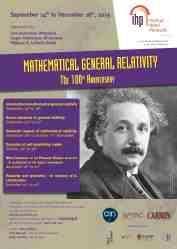
 Mathematical general relativity, compressible fluids, and more